


After slaughter, fresh meat retains its cellular structure. Moisture is primarily distributed within the myofibrils, between the myofibrils and cell membrane, between muscle cells, and among muscle bundles. The intrinsic muscle structure and postmortem handling methods significantly influence moisture distribution, directly affecting the water-holding capacity of fresh meat. As a result, changes in moisture during meat maturation and storage have drawn widespread attention.
Low-Field Nuclear Magnetic Resonance (LF-NMR) is a fast, non-destructive analytical technique that characterizes water states in meat by detecting the relaxation behavior of hydrogen nuclei in a magnetic field. LF-NMR has been widely studied in the meat industry, particularly in three main areas:
1) Measuring the distribution and migration of different water states in meat and meat products;
2) Evaluating eating quality and processing properties in combination with other indicators;
3) Detecting water or gel injection, identifying adulterated meat, and assessing meat freshness.
1.
Literature Conclusion: The proportions of immobilized and free water in meat are closely related to key quality indicators such as water-holding capacity and flavor. Correlation analysis reveals that during storage of yak meat, changes in physicochemical properties often coincide with changes in water mobility. T2 relaxation times can be used to assess yak meat quality under varying storage durations.
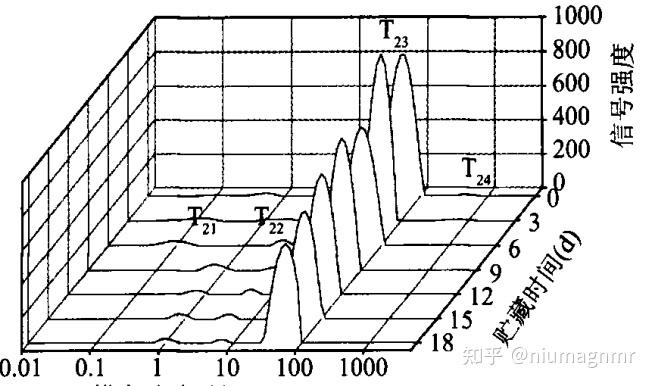
Correlation analysis among yak meat quality indicators
Source: Yuan Yiping, Li Jing, Ma Yuanxiao, et al. Quality evaluation of vacuum-packaged yak meat during low-temperature storage based on LF-NMR and physicochemical indexes [J]. Science and Technology of Food Industry, 2019, 40(06):31-36.
2.
Literature Conclusion: Correlation analysis between beef quality indicators and NMR T2 parameters shows strong relationships between T22 and various quality attributes, making it a reliable indicator for tracking beef quality changes. NMR imaging reveals that storage at −10°C results in significant moisture loss and poor water retention, making it unsuitable for long-term beef storage. Considering moisture loss and cost, beef should be stored below its glass transition temperature (Tg), ideally around −15°C to −20°C.
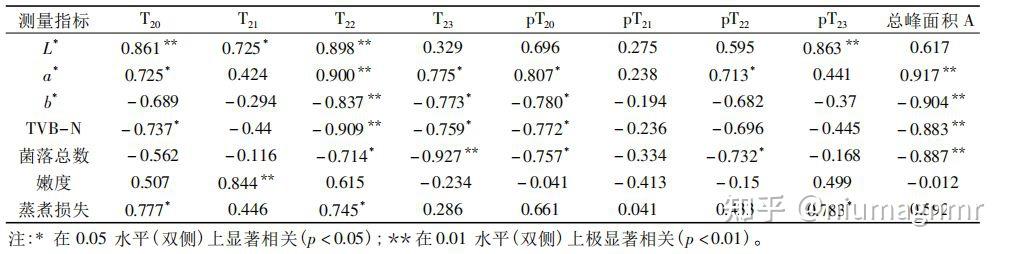
Correlation coefficients between LF-NMR T2 and beef quality indicators
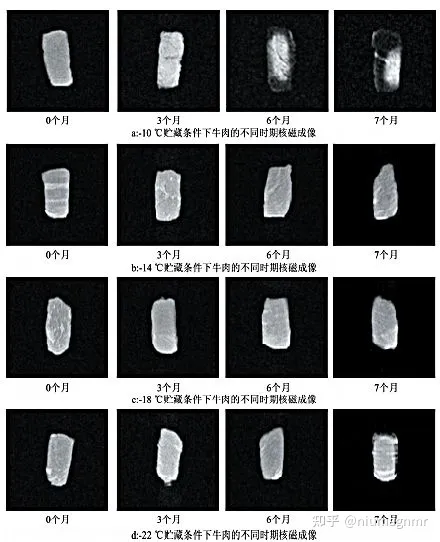
NMR images of beef under different storage temperatures and durations
Source: Ma Ying, Yang Jumei, Wang Songlei, et al. Analysis of water content changes in beef during storage based on LF-NMR and imaging technology [J]. Science and Technology of Food Industry, 2018, 39(02):278-284.
3
Literature Conclusion: Different thawing methods affect the T2 relaxation times of frozen pork in varying ways. During thawing, water migration occurs between different moisture states. LF-NMR T2 analysis shows significant effects of thawing method on water migration: refrigerated thawing promotes the shift from immobilized to free water; microwave thawing (method 1) tends to shift free water to immobilized water, while microwave thawing (method 2) favors migration from immobilized to bound water.
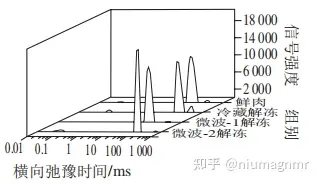
3D waterfall plot of T2 relaxation time changes in pork samples
T2 relaxation changes under different thawing methods
Source: Cheng Tianfu, Jiang Yi, Zhang Yifei, et al. Effects of different thawing methods on frozen pork quality based on low-field NMR analysis [J]. Food Science, 2019, 40(07):20-26.
Let’s walk through a recent case to understand the research approach and methodology in practice.
Source: Cheng Tianfu, Yu Longhao, Jiang Yi, et al. Effects of myofibrillar water on chicken quality during thawing based on low-field NMR [J]. Food Science, 2019, 40(09):16-22.
This study explores the relationship between myofibrillar water mobility and chicken meat quality during thawing using T2 relaxation time analysis with low-field NMR.
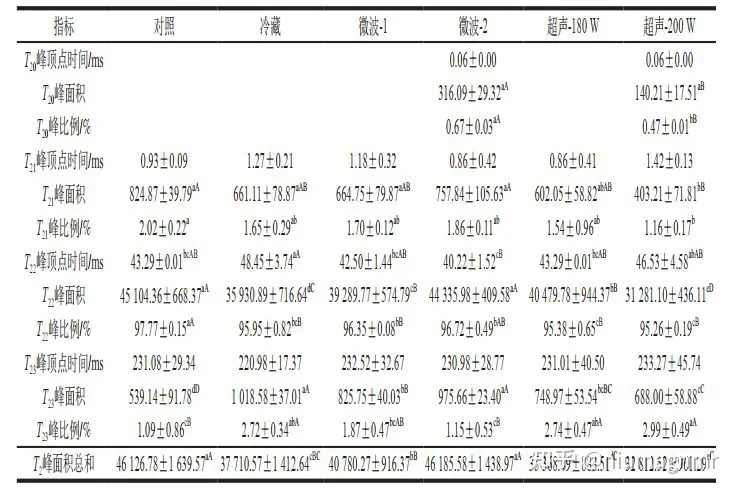
Fresh chicken breast (32 hours post-slaughter) was used as the control. Five thawing methods—refrigeration, microwave-1, microwave-2, and ultrasound (180 W, 200 W)—were applied to frozen chicken (−20°C). T2 relaxation times and meat quality indicators were measured and analyzed for correlation.
3D waterfall plot of T2 relaxation changes in meat samples
T2 relaxation variation under different thawing methods
Thawing methods significantly affected the T22 peak time and proportion (P < 0.05). Compared with the control, refrigeration and 200 W ultrasound thawing notably extended T22 peak times (P < 0.05) and shifted peaks to the right. Although no significant differences were found in peak time among the other three methods, microwave-thawed samples showed a trend of leftward peak shift.
All thawed samples exhibited significantly reduced T22 peak proportions compared to the control. Microwave-2 thawing showed a significant difference (P < 0.05), while the other four thawing methods showed extremely significant differences (P < 0.01).
This indicates that the thawing process reduces the proportion of immobilized water in frozen chicken breast muscle.
From a quality perspective, microwave-2 thawing is more suitable for frozen chicken breast due to minimal adverse effects on meat characteristics.
Water migration analysis showed that bound and immobilized water were significantly positively correlated with water-holding capacity, tenderness, and juiciness (P < 0.01), and significantly negatively correlated with thawing loss, cooking loss, and shear force (P < 0.01). In contrast, free water exhibited the opposite correlations.
Refrigerated, microwave-1, and both ultrasound thawing methods resulted in noticeable migration of immobilized water to free water, causing significant deterioration in meat quality. Microwave-2 thawing had the least negative impact and promoted the formation of strongly bound water, while also offering the natural advantage of faster thawing time.
Nuclear Magnetic Resonance (NMR) provides direct insights into interactions between water protons and exchangeable protons in proteins, offering valuable information on the physicochemical state of water in muscle tissue.
 Scan QR Code
 Scan QR Code
 Phone Support
Phone: 400-060-3233
After-sales: 400-060-3233
 WeChat Support

 Official Account

Back to Top