



Due to the low porosity, low permeability, multi-scale pore spaces, and complex fluid components, characterizing and developing shale oil reservoirs present significant challenges. Nuclear Magnetic Resonance (NMR) technology has a distinct advantage in shale oil reservoir characterization and development research due to its high resolution, non-destructive and rapid capabilities. This paper summarizes and looks ahead to the progress of NMR technology in shale oil exploration and development over the past decade.
The NMR technologies applied in shale oil exploration and development laboratory studies mainly include one-dimensional NMR T2 maps, two-dimensional NMR T1-T2 maps, MRI technology, and layered T2 technology. T2 maps non-destructively characterize the full pore size distribution of shale oil reservoirs, and can be combined with other experimental methods to expand their functionality:
(1) Combine with centrifugation and thermal treatment to determine the NMR T2 cutoff value, enabling quantitative separation of movable fluids, capillary-bound fluids, and immovable fluids (bound state);
(2) Combine with core holders to characterize the stress sensitivity of the shale matrix and fracture system;
(3) Combine with imbibition experiments to quantitatively evaluate imbibition patterns and wettability;
(4) Use an online high-temperature high-pressure CO2 displacement setup to quantitatively calculate dynamic recovery rates. Additionally, two-dimensional T1-T2 maps have unique advantages in identifying various fluid types and in-situ fluid content in shale oil layers under different reservoir conditions. During CO2 enhanced recovery in shale oil reservoirs, MRI technology has immense potential for characterizing the gas-liquid interface spatial distribution. Layered T2 technology provides spatially resolved T2 distributions of samples during CO2 flooding processes and gas-liquid interface distributions.
(1) NMR T2 spectral technology can non-destructively characterize the full pore size distribution of shale oil reservoirs, but there are technical gaps compared to low-temperature nitrogen adsorption and high-pressure mercury intrusion methods in analyzing pore geometry and specific surface area.
(2) By combining T2 spectra with centrifugation and thermal treatment, an NMR T2 cutoff calibration method can be established to achieve the three-phase quantitative separation of immovable fluids (bound state), capillary-bound fluids, and movable fluids (free state).

Figure 1: Calculation method for two T2 cutoff values of shale samples (Xu et al. 2022)
(3) Using a loadable confining pressure core holder, T2 spectra can dynamically monitor changes in core porosity under different effective stresses, quantitatively characterizing reservoir stress sensitivity.
(4) Combined with imbibition kinetics experiments, T2 spectra can simultaneously capture the saturation changes during the imbibition process and establish a wettability evaluation model.

Figure 2: Schematic diagram of NMR spontaneous imbibition experiment process (Wang et al. 2022)
(5) An online T2 monitoring system integrated into the high-temperature high-pressure CO2 displacement device enables in-situ non-destructive monitoring of fluid migration during the displacement process, significantly improving the reliability of dynamic recovery data.
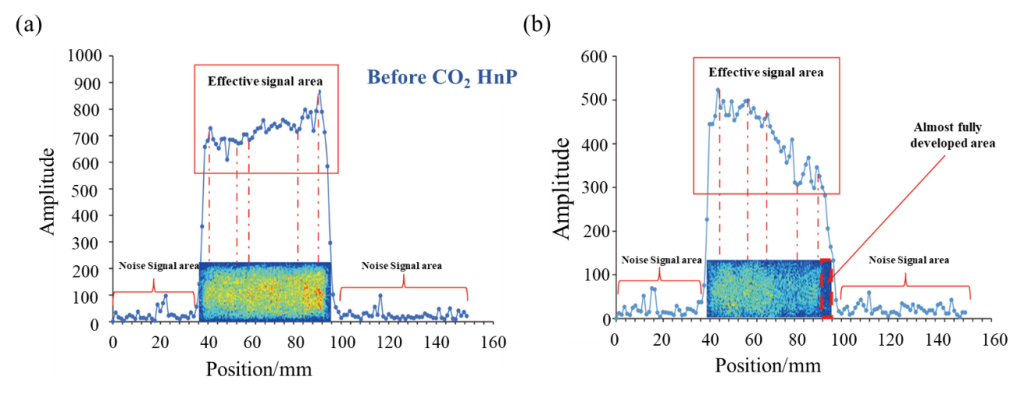
Figure 3: Spatial distribution of oil saturation before (a) and after (b) CO2 huff-n-puff experiment (Tang et al. 2023)
(6) Two-dimensional T1-T2 spectra have unique advantages in the quantitative identification of fluid types in shale reservoirs and distinguishing between solid kerogen, viscous bitumen, and fluids in different states (adsorbed and free).

Figure 4: Typical shale oil reservoir component identification T1-T2 maps (Top: Li et al., 2018; Bottom: Zhang et al., 2020)
(7) Layered T2 technology, through spatially resolved T2 distribution analysis, can reconstruct the oil saturation profile during displacement and assess the sweep efficiency based on CO2 front expansion characteristics.
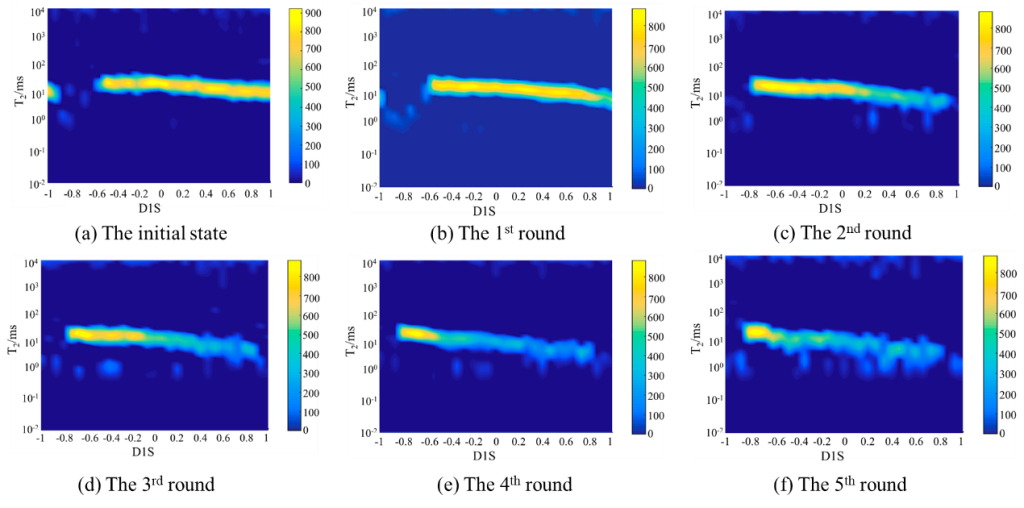
Figure 5: Spatial distribution characteristics of shale oil during CO2 huff-n-puff from rounds 1 to 5 (Luo et al. 2022)
(1) Two-dimensional T1-T2 spectra demonstrate significant technical advantages in identifying multicomponent fluid states (adsorbed/free) and quantitative analysis of in-situ fluid content in shale oil reservoirs.
(2) Two-dimensional T1-T2 spectra show engineering application potential in monitoring fluid migration during CO2 flooding, but their existing two-dimensional sequence measurement takes too long, limiting their rapid field response capability. Optimization of pulse sequences and hardware upgrades are needed to achieve breakthroughs in real-time dynamic monitoring.
(3) Magnetic Resonance Imaging (MRI) technology can dynamically capture gas-liquid interface migration characteristics during the displacement process. However, the current millimeter-level spatial resolution does not meet the observation requirements for ultra-low permeability shale micro-nano pore throat systems. With breakthroughs in imaging technology, it is hoped that online characterization of multiphase flow migration profiles in shale oil reservoirs can be achieved, thereby expanding the application boundaries of NMR technology in unconventional oil and gas development.
Xu, J., Ge, Y., He, Y., Pu, R., Liu, L., Du, K., Li, H., He, X., Duan, L., 2022. Quantification of pore size and movable fluid distribution in Zhangjiatan shale of the Ordos Basin, China. Geofluids 2022, 1–16.
Wang, H., Yang, L., Wang, S., Guo, D., Li, M., Zhao, Z., Dong, H., Zheng, Z., 2022. Study on imbibition characteristics of glutenite with different boundary conditions based on NMR experiments. Energy & Fuels, 36: 14101-14112.
Tang W, Sheng J, Jiang T. Further discussion of CO2 huff-n-puff mechanisms in tight oil reservoirs based on NMR monitored fluids spatial distributions[J]. Petroleum Science, 2023, 20:350-361.
Li, J., Huang, W., Lu, S., Wang, M., Chen, G., Tian, W., Guo, Z., 2018. Nuclear magnetic resonance T1–T2 map division method for hydrogen-bearing components in continental shale. Energy & Fuels, 32: 9043–9054.
Zhang, P., Lu, S., Li, J., Chang, X., 2020. 1D and 2D nuclear magnetic resonance (NMR) relaxation behaviors of protons in clay, kerogen and oil-bearing shale rocks. Marine Petroleum Geology, 114: 104210.
Luo, Y., Zheng, T., Xiao, H., Liu, X., Zhang, H., Wu, Z., Zhao, X., Xia, D., 2022. Identification of distinctions of immiscible CO2 huff and puff performance in Chang-7 tight sandstone oil reservoir by applying NMR, microscope and reservoir simulation. Journal of Petroleum Science and Engineering, 209: 109719.
 Scan QR Code
 Scan QR Code
 Phone Support
Phone: 400-060-3233
After-sales: 400-060-3233
 WeChat Support

 Official Account

Back to Top