


In recent years, the rapid growth of the new energy sector has driven a surge in demand for lithium ions (Li+). Extracting lithium from salt lake brines has become one of the most important sources of lithium. However, most brines contain high concentrations of magnesium ions (Mg2+) and relatively low concentrations of Li+, which poses a major challenge to lithium resource utilization. The key technical bottleneck lies in the poor selectivity during Li+/Mg2+ separation. Among cutting-edge separation methods, 2D membrane technology has demonstrated outstanding performance in Li+/Mg2+ separation. However, a fundamental trade-off still exists between permeability and selectivity. To overcome this, optimizing the membrane’s microstructure has become critical for achieving both high flux and selectivity. Two-dimensional (2D) materials—materials with thicknesses of only one or several atomic layers—have emerged as promising candidates for fabricating high-performance separation membranes.
In this application, the authors developed a high-permeability and highly stable composite membrane (ZIF-8@MLDH) by in situ deposition of functional ZIF-8 nanoparticles into nanopores formed at framework defects in a layered double hydroxide (MLDH) membrane.
Additionally, the authors innovatively utilized a low-field NMR device to characterize the microstructure of the separation membrane—a level of structural insight that cannot be obtained through conventional XRD or electron microscopy. The application of low-field NMR provides a new pathway to better understand the spatial architecture of 2D membrane materials.
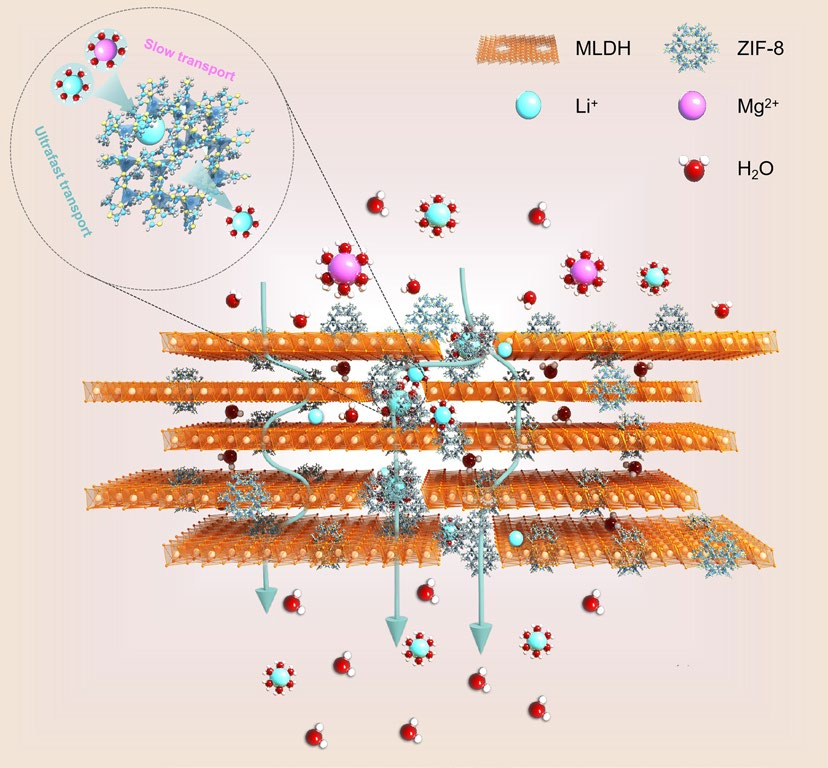
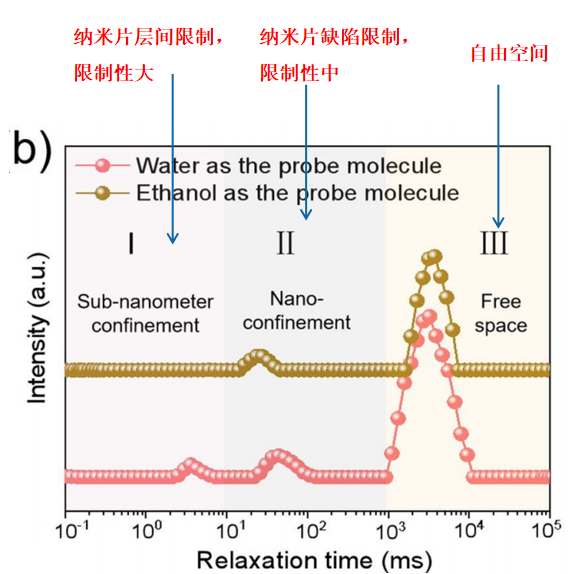
Figure 1: Relaxation time spectrum using water and ethanol to deliver ZIF-8 nanoparticles as probes
In this study, water or ethanol was used to carry ZIF-8 nanoparticles as probe molecules to characterize the microstructure of the 2D membrane. As a separation membrane, a 2D material presents three distinct environments for the probe: First, the interlayer spaces between nanosheets, which are extremely confined and tortuous, restrict probe movement and result in short relaxation times (0.1–10 ms); second, nanosheet defect regions, where the restriction is moderate, with relaxation times typically ranging from 10 to 103 ms; and third, open free spaces where probe molecules experience no restriction, resulting in long relaxation times (103–104 ms).
As shown in Figure 1, there was no change observed in the 0.1–10 ms range, which corresponds to interlayer regions. This confirms that the ZIF-8 nanoparticles did not deposit between the 2D nanosheets. However, a distinct peak emerged in the 10–103 ms range, indicating that ZIF-8 nanoparticles had deposited at defect sites within the membrane framework. This experiment successfully identified the specific deposition region of the ZIF-8 nanoparticles.
This application demonstrates the use of low-field NMR to characterize the microstructure of separation membranes, offering a novel approach for spatial structural analysis of 2D materials.
If you are interested in this application, feel free to contact us at: 15618820062
[1] Yahua Lu, Rongkun Zhou, Naixin Wang, et al. Engineer Nanoscale Defects into Selective Channels: MOF-Enhanced Li+ Separation by Porous Layered Double Hydroxide Membrane. Nano-Micro Lett, 2023, 15(9): 325–336.
 Scan QR Code
 Scan QR Code
 Phone Support
Phone: 400-060-3233
After-sales: 400-060-3233
 WeChat Support

 Official Account

Back to Top