


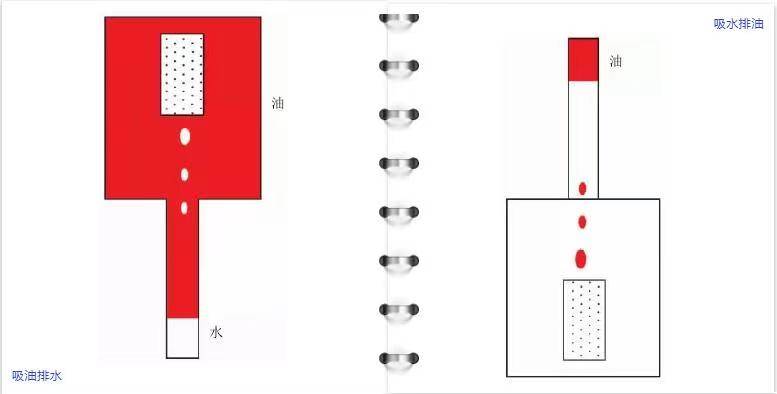
Spontaneous imbibition is an effective method for extracting crude oil from the matrix pores, but the driving mechanism has long remained a challenge. It is generally understood as the process where a wetting fluid is spontaneously drawn into pores under capillary forces, displacing non-wetting fluids. Depending on the imbibition direction, it can be classified as co-current or counter-current imbibition; based on fluid saturation order, it can be oil-displacing-water or water-displacing-oil, as illustrated below.
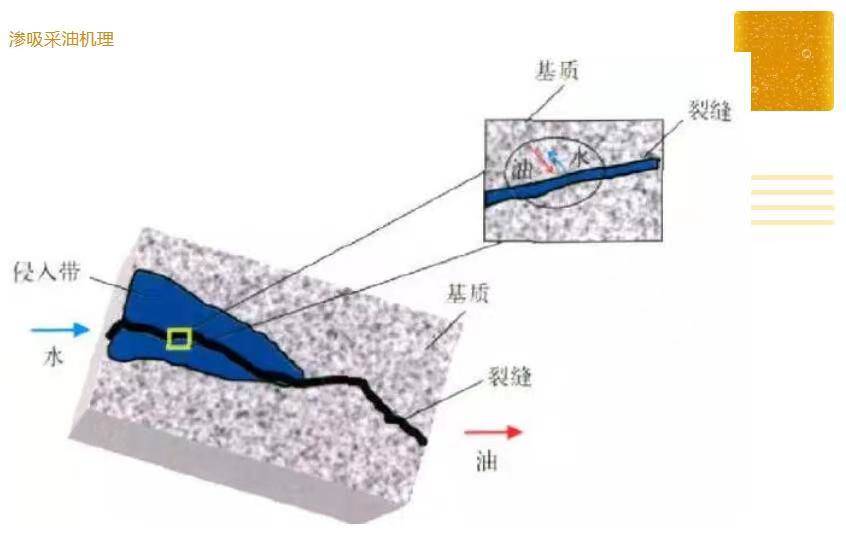
In natural microfractures, fluid flow is primarily governed by Darcy flow, while in the matrix system, fluid exhibits spontaneous imbibition and low-velocity non-Darcy flow characteristics. As production progresses, a significant portion of residual oil remains trapped in the micro-pores of the matrix, which cannot be efficiently recovered by pressurised displacement, relying instead on capillary-driven imbibition. Therefore, the recovery efficiency of tight reservoirs is controlled by both displacement efficiency and the spontaneous capillary imbibition efficiency. The intensity of imbibition is directly related to reservoir permeability: the lower the permeability, the stronger the imbibition effect. In tight reservoirs, the potential of matrix oil mobilised via imbibition exceeds that in medium-to-high permeability reservoirs, making spontaneous imbibition a key mechanism for effective development of fractured tight oil reservoirs.
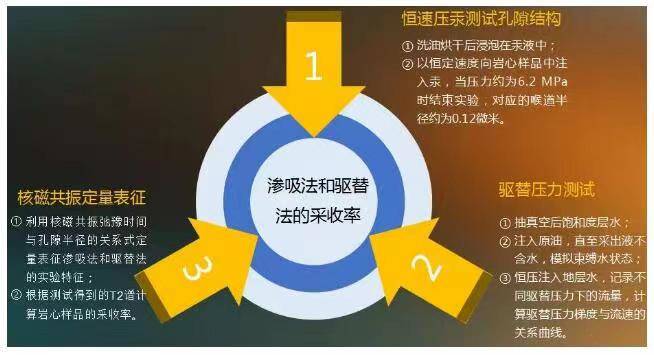
The study analysed recovery changes under imbibition and displacement conditions using NMR (nuclear magnetic resonance) and mercury injection tests. Samples were taken from the Chang-8 formation in the Yanchang Oilfield, representative of typical tight reservoir rocks. The experimental setup is illustrated below.
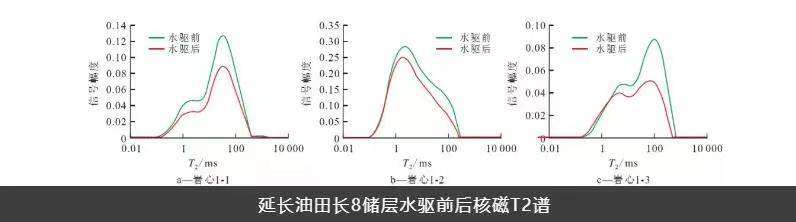
From the NMR T₂ spectra of Chang-8 core samples before and after displacement, it is evident that during water flooding, the decrease in oil reduces the oil-phase relaxation signal. The amplitudes of both left and right T₂ peaks decrease, with the right peak reducing more significantly. This indicates that injected water primarily displaces oil in large and medium pores. Residual oil has a relaxation time below 100 ms and a higher peak, suggesting that most displaced oil comes from large pores, while residual oil mainly resides in medium-to-small pores.
From NMR T₂ spectra before and after imbibition, the oil-filled pore size distribution initially shows two peaks at original oil saturation: the left peak corresponds to small pores, and the right peak to large pores. After spontaneous imbibition, amplitudes of both peaks decrease compared with the original, indicating very small pore radii in the tight reservoir and strong capillary-driven imbibition. Oil in small pores is expelled as water is imbibed, highlighting the critical role of spontaneous imbibition for improving recovery in tight reservoirs.
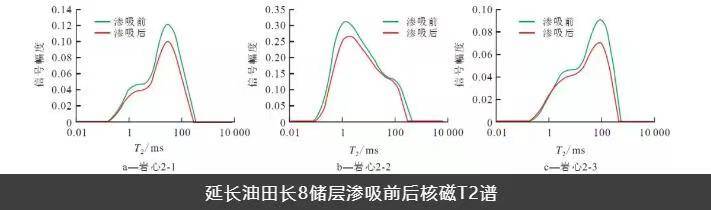
Experimental results from six core samples of Chang-8 formation show that displacement yields range from 32.30% to 39.32%, while imbibition yields range from 9.60% to 19.49%. Although displacement yields are higher, the pressure gradients applied in laboratory displacement experiments exceed those encountered in the field. Excessive injection pressures can challenge equipment and operational procedures. Therefore, in field applications, it is essential to leverage the complementary effects of imbibition and displacement.
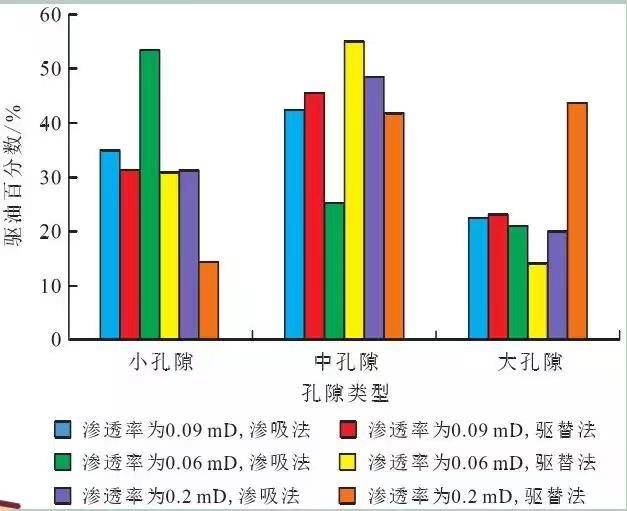
The recovery percentage for different pore types is defined as the ratio of oil produced from that pore type to the total oil produced. Using the relationship between relaxation time and pore radius, NMR T₂ spectra before and after water flooding and imbibition can be converted to pore radius, allowing calculation of recovery percentages, as illustrated below.
 Scan QR Code
 Scan QR Code
 Phone Support
Phone: 400-060-3233
After-sales: 400-060-3233
 WeChat Support

 Official Account

Back to Top