


Low-field Nuclear Magnetic Resonance (LF-NMR), a fast and non-destructive technology, was used to monitor the dynamic changes in moisture during various drying processes of Japanese Littleneck Clams (Tapes japonica), and to distinguish samples processed by different drying methods.
A CPMG pulse sequence was used to measure the transverse relaxation time (T2), while low-field NMR imaging captured real-time changes in moisture distribution and internal structure throughout the drying process.
The resulting samples showed a more compact water composition, with almost no free water detected. The Page model was applied to describe hot air drying and natural sun-drying processes. T2 relaxation data showed strong correlation with actual moisture content during drying.
Different drying methods also influenced the rehydration process. Samples dried via hot air exhibited slower water absorption in the early stage compared to sun-dried samples, but absorption accelerated later. The binding strength of water molecules was lower, closely resembling that of fresh clams.
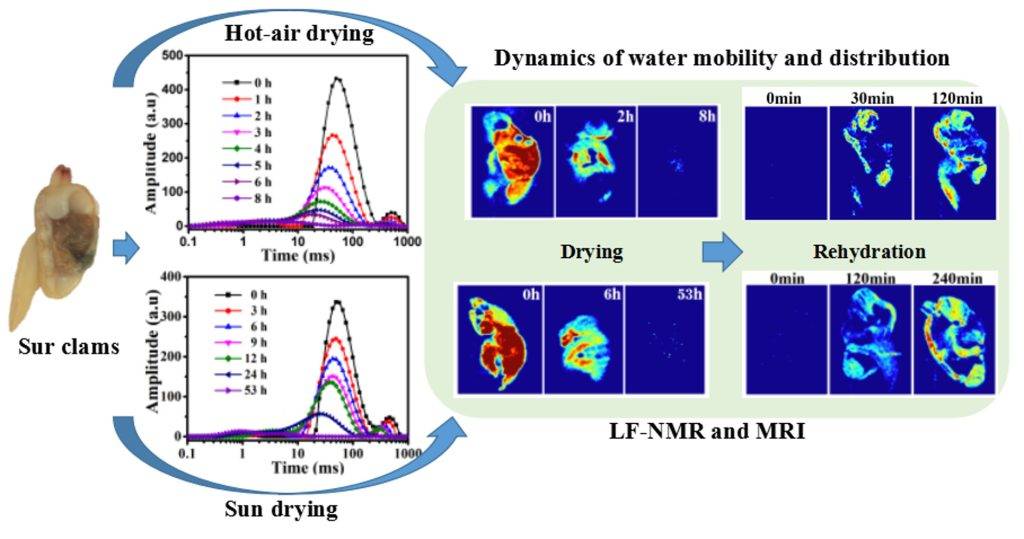
Figure 1. T2 relaxation data and MRI imaging during drying and rehydration
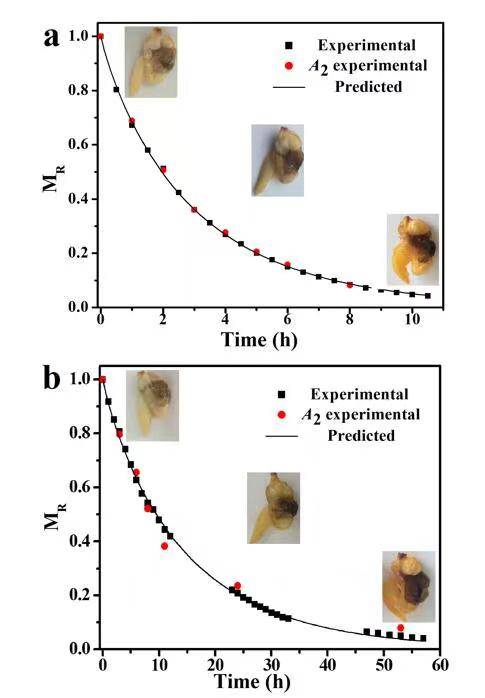
Figure 2. Hot-air drying curve (a) and sun-drying curve (b): Actual moisture vs. NMR peak area
LF-NMR is highly suitable for assessing how different drying methods affect moisture composition, and for tracking moisture distribution and migration throughout the drying process. T2 relaxation times demonstrate strong correlation with actual water content.
Submitted for the Niumag Application Case Competition: “Study on Moisture Distribution and Migration During Drying of Japanese Littleneck Clams” by Wang Siqi, Dalian Polytechnic University.
Instrument used:
NMI20 Series Benchtop NMR Analyzer
 Scan QR Code
 Scan QR Code
 Phone Support
Phone: 400-060-3233
After-sales: 400-060-3233
 WeChat Support

 Official Account

Back to Top