


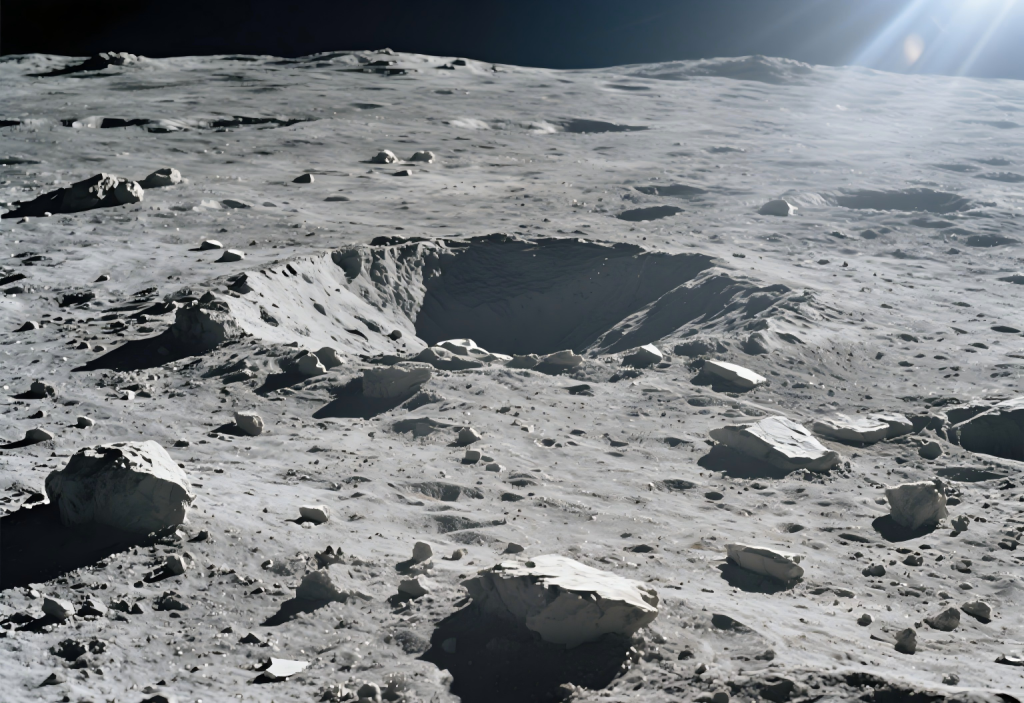
Space geotechnical materials such as lunar regolith and Martian soil are loose materials that cover the surfaces of the Moon and Mars. They include dust, sand, and rocks, and are crucial for understanding the geological evolution of the Moon and Mars, human exploration, and even planetary colonization. However, directly obtaining real lunar and Martian soil samples is costly and technically challenging. Currently, only a few countries have managed to collect tiny amounts of lunar soil, while Martian soil, which is farther from Earth, can only be analyzed in situ by probes, with sample return missions yet to be realized. Therefore, space geotechnical simulants have become a widely researched alternative.
Low-field nuclear magnetic resonance (NMR) technology, a non-destructive online characterization technique, is ideal for precious samples. A single test provides multidimensional data, including pore structure, moisture state, saturation, and other physical parameters. It has been widely applied in energy geotechnical properties testing. As humanity continues to explore space, what can low-field NMR technology do for space geotechnical materials and simulants?
1. Moisture Distribution and Migration Mechanism: Distinguish between adsorbed and bound water in space geotechnical materials, analyze moisture states (such as unfrozen water content in frozen soils) and migration behavior, assisting in assessing the availability of extraterrestrial water resources.
2. Material Hydration Process and Strength Analysis: Real-time in situ monitoring of the hydration process of Martian soil-based and lunar soil-based composites with cement materials, revealing the relationship between hydration degree and pore evolution to optimize material formulation.
3. Pore Structure and Porosity Characterization: Low-field NMR detects hydrogen proton relaxation time differences to quantify the pore distribution, pore size, and porosity changes in Martian soil-based materials and lunar soil-based materials (such as sintered bricks and cement-based composites), directly correlating with the materials’ mechanical properties and durability.
In addition to the above physical property testing based on space geotechnical composite materials, low-field NMR can support many other open research topics. With the goal of long-term human presence or even colonization on the Moon, Mars, and other celestial bodies, the need for self-sustained food production arises due to the high cost of transporting resources from Earth. Using lunar and Martian soil for agricultural planting has become a core solution. Topics such as how Martian soil absorbs and retains moisture, the distribution of water forms (free water, bound water), and physical structure (hydrophobicity) need further research, thus guiding the modification of Martian soil for plant growth.
Martian soil has specific characteristics: its mineral composition is dominated by basalt, containing minerals such as olivine, pyroxene, and magnetite. It is highly saline (with sulfate and perchlorate salts), strongly hydrophobic, and lacks organic matter and microbial communities, making it unable to directly support plant growth. Using low-field NMR, the effect of Martian soil simulants on plant growth can be studied, and guidance for soil modification on Mars can be provided. Currently, dozens of Martian soil simulants have been artificially synthesized worldwide, with MGS-1 chosen as the representative simulant for this study.
Two samples of Martian soil simulant (MGS-1) were tested. Sample 1 has a moisture content of 5.5%, while Sample 2 has a moisture content of 4.5%. Both samples contain a certain amount of paramagnetic substances. A low-field NMR small diameter coil from Niumag was used, and an FID sequence was applied to record the free induction decay (FID) signal of the MGS-1 samples:
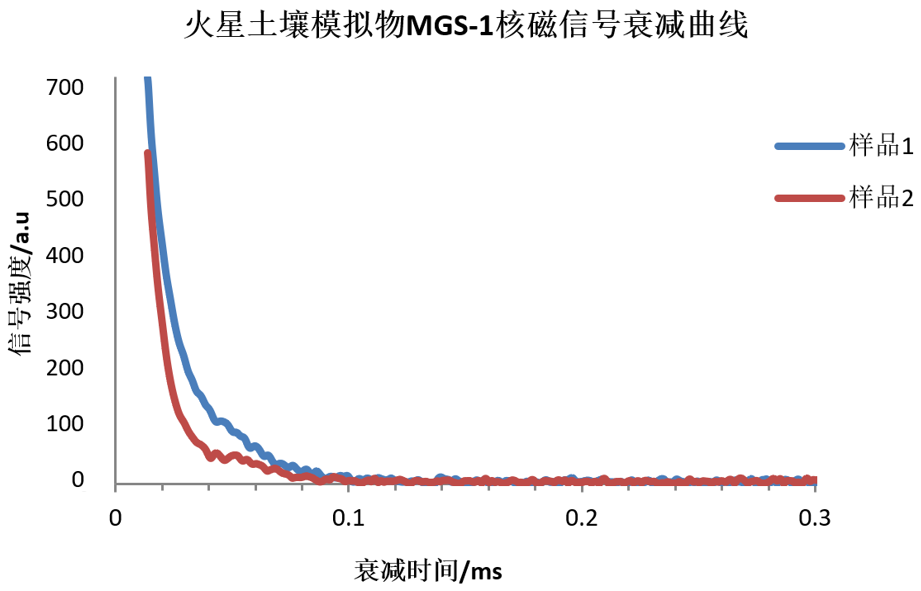
The X-axis (horizontal) represents time (in milliseconds), showing the progress of the signal recording. The Y-axis (vertical) represents NMR signal strength, reflecting changes in the magnetic intensity of protons in the sample. The FID signal is a fitted curve that decays exponentially with time. According to the NMR signal, only tightly bound water is detected, and no signals for relatively loose bound water or free water are observed. The rapid decay rate (short relaxation time) indicates significant effects from paramagnetic ions (e.g., Fe²⁺), which accelerate relaxation decay. This aligns with the high iron oxide content characteristic of Martian soil.
1. FID signal analysis confirms that MGS-1 exhibits high hydrophobicity:
Only tightly bound water exists, with low water molecule mobility, indicating strong interaction between water molecules and the mineral surface, but few hydration sites. The limited and tightly bound water presence highlights the material’s hydrophobicity, which is one of the key factors hindering plant growth.
2. Technological Guidance:
This analysis provides molecular-level insights into the hydration mechanism of Martian soil, emphasizing the need for future Martian agriculture to improve soil hydrophobicity (e.g., by adding organic matter or hydrophilic materials).
If you are interested in the above applications, feel free to consult: 18516712219
 Scan QR Code
 Scan QR Code
 Phone Support
Phone: 400-060-3233
After-sales: 400-060-3233
 WeChat Support

 Official Account

Back to Top