


It is well known that core flooding experiments are a key technique for studying oil and gas migration patterns. They help to understand and characterise fluid flow mechanisms within reservoirs, providing valuable guidance for the scientific and efficient development of oil fields[1]. However, conventional core physical simulation experiments typically use short cores, which exhibit significant end-face effects, limiting their ability to accurately reflect internal parameter variations during flow. This can negatively impact research into reservoir flow mechanisms.
Several methods have been developed to reduce the impact of end-face effects in core flooding experiments. For example, using longer cores can improve the fidelity of the displacement evaluation by mitigating end-face effects. However, this approach does not completely eliminate the influence, and in some cases, experimental setups cannot accommodate longer cores. Modifying apparatus for longer cores can also be inconvenient. Additionally, some researchers have proposed correction formulas for relative permeability curves based on extensive experimental data. These formulas are generally applicable to medium- and high-permeability cores, but their suitability for low-permeability tight cores remains uncertain.
Newmae has introduced a constant-gradient layered technique, which fundamentally eliminates end-face effects from a technical standpoint, providing a more accurate evaluation of core flooding performance. This technology preserves the original precision of NMR measurements and is suitable for a wide range of core types, including sandstone and shale, without being limited by low-permeability tight cores[2].
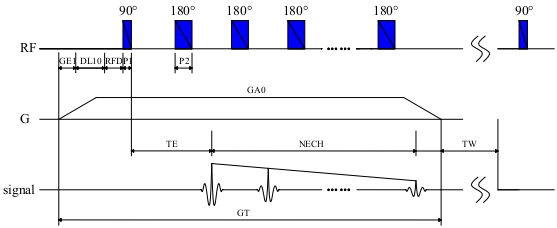
SFG-MSCPMG Pulse Sequence
Unlike CPMG sequences that collect data from the entire sample, the constant-gradient selective-layer sequence applies a layer-selection gradient field combined with selective RF pulses to acquire layered CPMG data along the sample axis. The figure above illustrates the pulse sequence of the constant-gradient selective-layer method. During testing, NMR signals from different positions along the sample experience the gradient field generated by the gradient coils, providing position-specific information. By mathematical decoding, the NMR signals are assigned to each layer. One-dimensional NMR localisation includes both layer positioning and thickness selection, as demonstrated below.
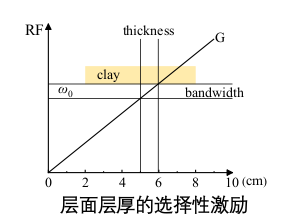
Selective excitation uses an RF pulse with a limited bandwidth to excite only protons with resonance frequencies within that range. When a gradient is applied along the Y-axis, layer-selective pulses can excite specific layers, while protons outside the selected layer remain unexcited. This sequence allows the acquisition of T2 distributions for individual layers and a pseudo-colour visualisation of the entire sample.
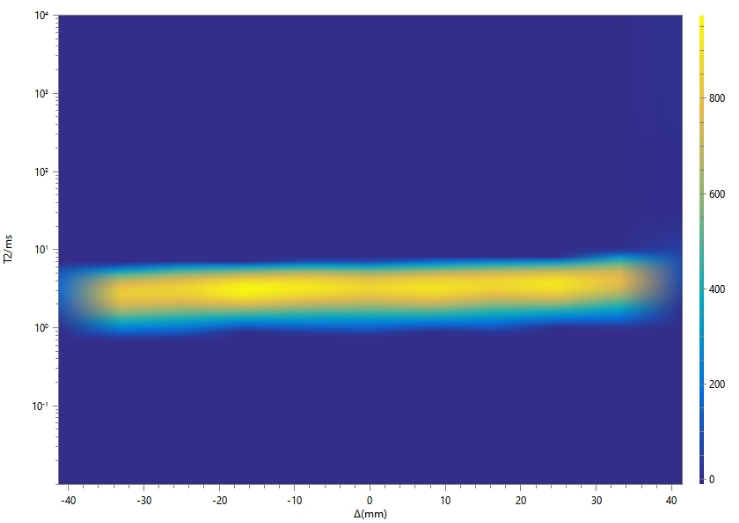
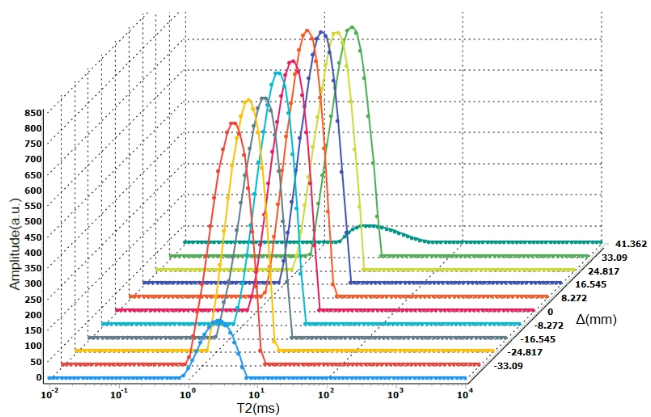
Sample and Corresponding Layered T2 Maps
Sample information and experimental conditions: artificial homogeneous core; diameter 1 inch; length 80 mm; porosity 9.8%; confining pressure 10 MPa; displacement pressure 8 MPa.
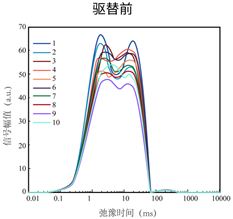
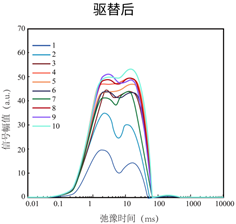
Layered T2 Spectra Before and After Flooding
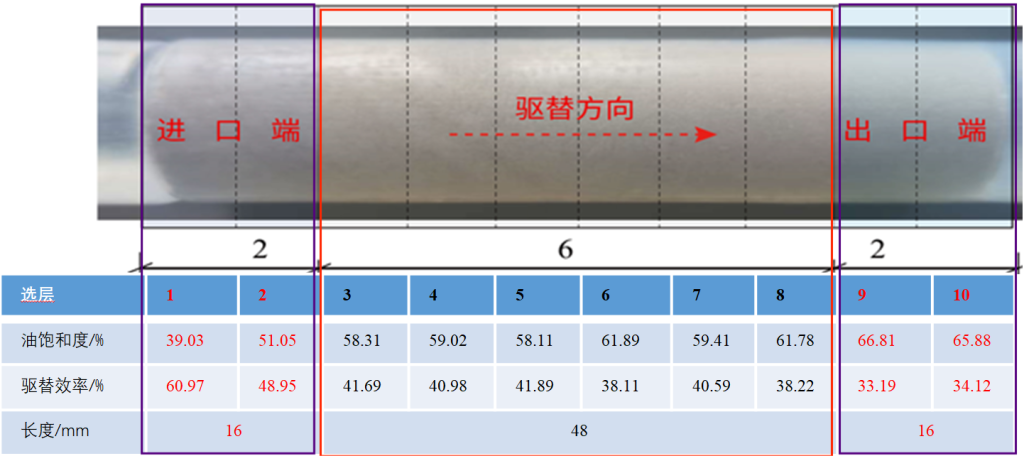
As shown above, the constant-gradient layered technique was used to evaluate the displacement efficiency of each core layer. The purple regions at both ends indicate end-face effects, while the central red region represents the effective displacement segment with end-face effects removed. The overall displacement efficiency was 41.87%, while the displacement efficiency after eliminating end-face effects using the constant-gradient selective-layer technique was 40.25%.
For inquiries regarding this application, please contact: 15618820062
[1] Chang Y H, Xiao S B, Ma R, et al. Unraveling the influence of surface roughness on oil displacement by Janus nanoparticles[J]. Petroleum Science: English Edition, 2023, 20(4):2512-2520.
[2] Hou Ren X, Ke Long Y, et al. Influence of pore structure on the moisture transport property of external thermal insulation composite system as studied by NMR[J]. Construction and Building Materials, 228(2019).
 Scan QR Code
 Scan QR Code
 Phone Support
Phone: 400-060-3233
After-sales: 400-060-3233
 WeChat Support

 Official Account

Back to Top