


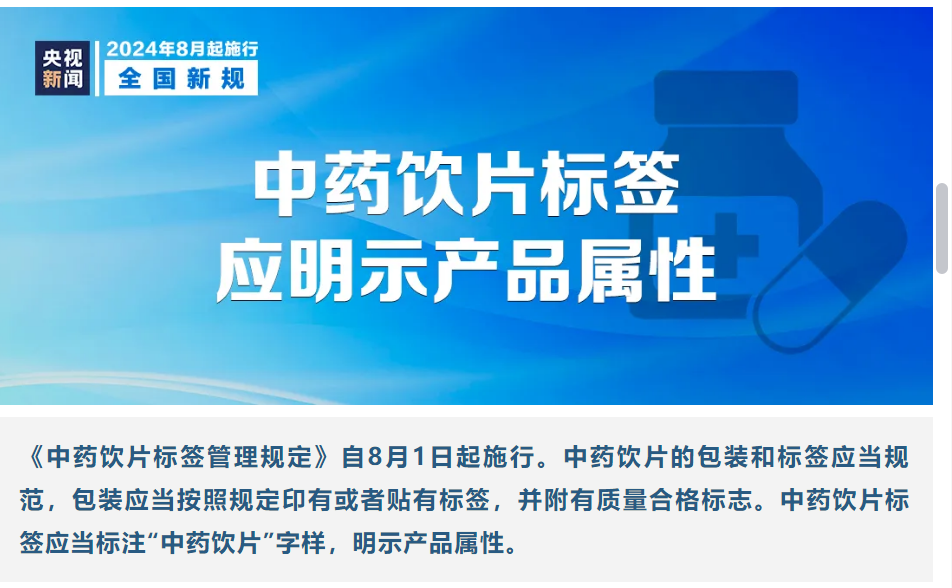
A new nationwide regulation on traditional Chinese medicine (TCM) decoction pieces takes effect this month. The Provisions on the Administration of Labels of TCM Decoction Pieces, issued by the National Medical Products Administration, came into force on 1 August 2024. The requirement for shelf-life labeling will apply from 1 August 2025. The definition of decoction pieces follows the General Rules for Processing in the Chinese Pharmacopoeia[1]: depending on the properties of the raw materials and the needs of dispensing, preparation, and clinical use, a set of specific pharmaceutical techniques is employed. Raw materials that have undergone cleaning, slicing, or processing (e.g., roasting or calcining) are referred to as “decoction pieces.”

In 2023, China’s Ministry of Science and Technology also highlighted the development of key technologies for intelligent sensing, process control, and online monitoring in TCM as an integral part of the field’s modernization and digital transformation. The combination of LF-NMR (low-field nuclear magnetic resonance) and PAT (process analytical technology) can significantly enhance quality and efficiency throughout TCM processing.
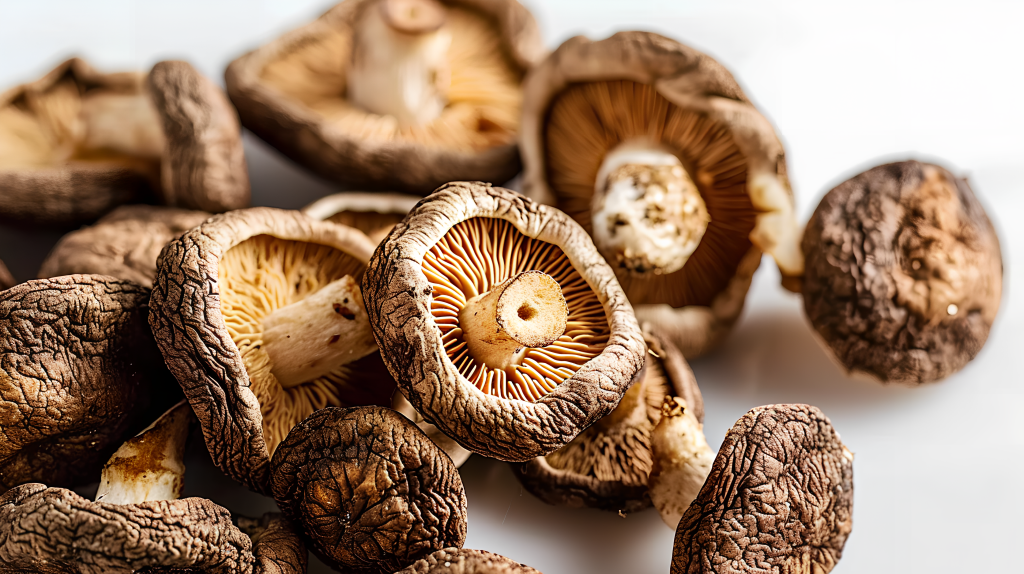
In food drying, Prof. Min Zhang’s team at Jiangnan University developed an online moisture detection device for microwave vacuum drying of fruits and vegetables based on LF-NMR[2]. They validated it on representative materials including carrot, shiitake mushroom, and potato, enabling intelligent end-point control of drying.
In agri-food processing, the Institute of Agro-Products Processing, Chinese Academy of Agricultural Sciences, built a moisture analysis platform[3] that, under constant temperature and humidity, enables real-time, online, in-situ measurement of moisture content, state, and distribution. It captures high-precision moisture levels, binding states, proton density maps, and their time-dependent evolution.
LF-NMR has already been used to characterize processing methods such as calcining[4], drying[5], and moistening[6] in the preparation of decoction pieces.
Here we add a new platform approach[7] that can simulate the moistening-before-slicing technique. Following the principle of “short soak, longer moisten; ensure full penetration with minimal residual water,” it maintains constant humidity to allow continuous monitoring of the sample.
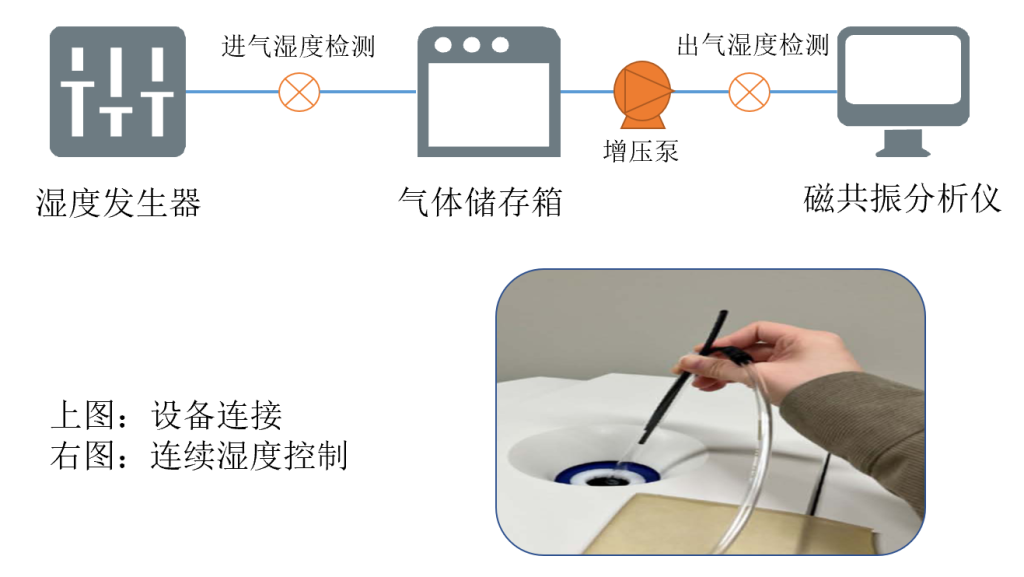
Weigh 200 mg of the dried sample and place it in an NMR tube. Connect a humidity controller to the tube and deliver humidity-controlled air (80% RH) into the tube via a pump.
Starting at 0 min, measure relaxation times every 30 min, and evaluate their changes until 241 min. At that point, the sample completes the moisture adsorption process.
Continuous monitoring of relaxation times reveals stability during moisture uptake. These insights guide optimization of softening steps prior to slicing, helping preserve pharmacological activity and key constituents.
This article recommends a new platform that combines low-field NMR with process analytical technology. The integrated approach is suitable not only for studying drying kinetics of foods, medicinal materials, and wood, but also as an experimental platform or engineering tool for equipment and process design in TCM decoction piece manufacturing.
Interested in these applications?
Contact us: 15618820062
[1] Pharmacopoeia of the People’s Republic of China, 2020 edition, Volume IV, General Rules 0213: Processing.
[2] Lv W. Q., Zhang M., Bhandari B., et al. Smart NMR method for measuring moisture content of vegetables during microwave vacuum drying. Food & Bioprocess Technology, 2017, 10(12): 2251.
[3] Xiaolei Yu, Zhenhua Wang, Yingquan Zhang, Syed Abdul Wadood, Yimin Wei. Study on the water state and distribution of Chinese dried noodles during the drying process. Journal of Food Engineering, 2018, 233: 81–87. ISSN 0260-8774.
[4] Liu Kaiyang, Han Shu, Tang Yanan, et al. Analysis of the hydration process of gypsum and its calcined products by low-field NMR. Beijing Journal of Traditional Chinese Medicine, 2021, 40(10): 1157–1160. DOI:10.16025/j.1674-1307.2021.10.028.
[5] Zheng Yao, Lei Lei, Ai Jiao, et al. Moisture states and chemical composition changes during drying/rehydration of fresh ginseng. Chinese Traditional and Herbal Drugs, 2019, 50(14): 3302–3312.
[6] Peng Jie, Wu Menghua, Ma Zhiguo, et al. Study on the moistening process of Angelica sinensis using water-absorption kinetics and modern techniques. China Journal of Chinese Materia Medica, 2022, 40(12): 96–99+289–291. DOI:10.13193/j.issn.1673-7717.2022.12.020.
[7] Takashi Ono, Kotaro Okada, Misaki Kaga, Hidekatsu Eto, Shungo Kumada, Nobuyuki Wakui, Yoshinori Onuki. Continuous Monitoring of Pseudopolymorphic Transition in Ezetimibe Using T1 Relaxation with Time-Domain NMR. Chemical and Pharmaceutical Bulletin, 2024, 72(7): 676–680. Released on J-STAGE July 17, 2024. Online ISSN 1347-5223; Print ISSN 0009-2363.
 Scan QR Code
 Scan QR Code
 Phone Support
Phone: 400-060-3233
After-sales: 400-060-3233
 WeChat Support

 Official Account

Back to Top