


Crude oil refers to unrefined animal or plant-based oils extracted by pressing or solvent methods. These oils contain various impurities, moisture, and colloids, which can affect quality and significantly reduce shelf life.
Refining is the process of converting crude oil into edible oil by removing water, soap, gums, solvents, impurities, odors, and pigments.

Rice bran oil processing flow
Crude rice bran oil was collected from a local processing facility and filtered before use.
Three types of vegetable oils (peanut, olive, and sunflower oil) were purchased from retail stores and used as-is.

Detection of a Characteristic Peak
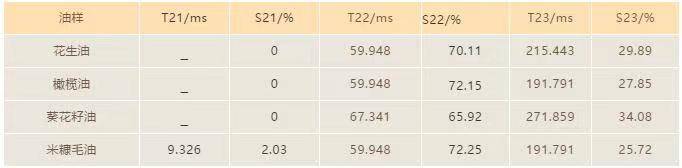
Using low-field NMR, the nuclear magnetic profiles of crude rice bran oil and three edible oils (peanut, olive, sunflower) were obtained and subjected to multi-component inversion. The relaxation spectra and NMR parameters are shown in Figure 1 and Table 1.
Compared to the other edible oils, rice bran oil exhibits an additional small peak near 10 ms in the relaxation spectrum—indicating the presence of free fatty acids and impurities due to its unrefined nature. This distinct T21 peak does not appear in the spectra of the refined oils and can therefore serve as a qualitative marker for rice bran oil adulteration.
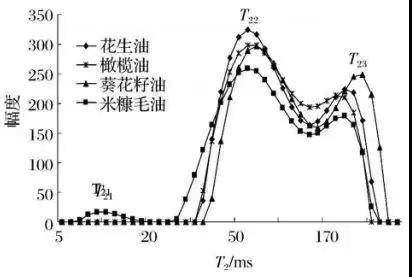
Figure 1: Relaxation spectra of peanut, olive, sunflower, and crude rice bran oils
Table 1: Relaxation times (T2) and component distributions for four oil samples
Detection of Adulteration at Varying Ratios
To verify the persistence of the T21 peak after adulteration, rice bran oil was blended into each of the three edible oils at varying concentrations (0% to 100%). As shown in Figure 2, increasing the proportion of rice bran oil leads to noticeable shifts in relaxation peaks. While T22 and T23 changes are minimal, the T21 peak becomes increasingly prominent as adulteration increases—confirming its reliability as a qualitative indicator.
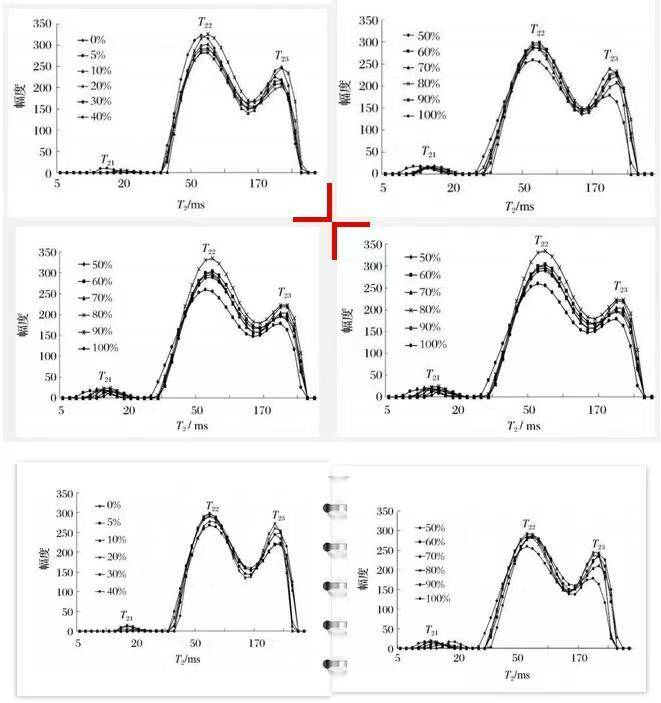
Figure 2: Relaxation spectra of oils adulterated with different ratios of rice bran oil
Quantitative Analysis of Rice Bran Oil Adulteration
The T21 peak area (S21) increases proportionally with adulteration levels. A calibration curve was created using S21 as the x-axis and adulteration percentage as the y-axis.
As shown in Figure 3, a strong linear relationship was observed (R² = 0.995), indicating that rice bran oil content can be quantitatively determined through T21 peak area.
Regression equation for rice bran oil adulteration in vegetable oil:
K (%) = 48.792 × ω + 2.2831
Where:
K = Adulteration percentage
ω = Proportion of S21 (% of total peak area)
To verify the model, peanut oil samples adulterated with rice bran oil were analyzed. The calculated values closely matched the actual adulteration levels (see Table 2), proving the calibration curve is accurate and applicable for quantitative detection.

Figure 3: Calibration curve for rice bran oil adulteration
Table 2: Comparison of actual vs. calculated adulteration in peanut oil samples

1. By analyzing the NMR signals and conducting multi-component inversion, detailed information such as relaxation spectra, T2 values, and component peak ratios can be extracted. This enables quick, accurate distinction between qualified edible oils and crude rice bran oil. The strong linear correlation between T21 and adulteration level further allows for quantitative analysis.
2. The T21 peak near 10 ms is also present in other low-quality oils (e.g., other crude oils, frying oils, rancid fats), suggesting this method can be broadly applied to initial screening of edible oil adulteration.
3. Compared to traditional detection methods, NMR technology preserves sample integrity, provides rapid results (within 8 seconds per sample), requires no complicated preprocessing, and delivers high repeatability—making it a highly promising tool for oil quality and adulteration detection.
Zhou Ning, Liu Baolin, Wang Xin, et al. Detection of Rice Bran Oil Adulteration in Edible Oils by Low-Field NMR [J]. Food and Fermentation Industries, 2011, 37(3):177–181.
Editor: Xiao Z from Niumag. For more cutting-edge applications of low-field NMR, follow Niumag’s official WeChat channel.
 Scan QR Code
 Scan QR Code
 Phone Support
Phone: 400-060-3233
After-sales: 400-060-3233
 WeChat Support

 Official Account

Back to Top