


Based on how water binds to wood and its location, it can be classified into three types: free water, bound water, and chemically combined water. The majority of water in wood exists as free water and bound water, while chemically combined water is minimal. In practical applications, bound water plays a crucial role in influencing the properties of wood.
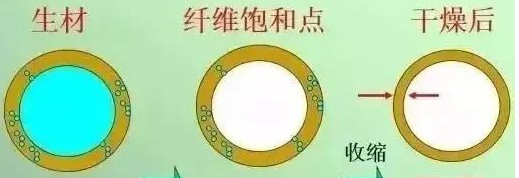
The capillary system in wood consists of two main networks: large capillaries and microcapillaries. Water resides within these capillary systems.
The large capillary system, formed by cell lumens, binds water very weakly, almost without any restriction. Water can freely evaporate from cross-sections of the large capillaries. Therefore, water present in the large capillary system is termed free water. Changes in free water content affect only the weight, storage, and combustion properties of wood, without influencing its inherent properties.
The microcapillary system, formed by interconnected cell walls, binds water to varying degrees. For water in microcapillaries to evaporate into the air, ambient humidity must be reduced to a certain level or heating must accelerate water movement to overcome capillary binding. Additionally, microcapillaries can absorb moisture from the air under suitable conditions. Water in the microcapillary system is therefore called bound water. Changes in bound water content not only cause wood to swell or shrink but also influence other physical and mechanical properties of wood.
The moisture content of wood cell walls (bound water) when fully saturated, while the cell lumens contain no free water, is called the fiber saturation point (FSP). It is typically around 30%, though it varies slightly among different wood species.
The fiber saturation point marks the threshold for changes in wood properties. Below FSP, cell wall fibers absorb water like compressed sponges, causing wood to swell; moisture content rises and strength decreases. At FSP, cells and intercellular spaces act like reservoirs, storing water, with minimal changes in volume or properties. Above FSP, water loss does not significantly affect volume or properties, whereas below FSP, water loss leads to wood shrinkage and increased strength.
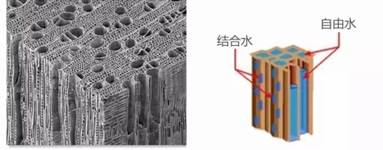
In simpler terms, during wood drying, maintaining the fiber saturation point around the 30% threshold ensures optimal hardness. Failure to properly control moisture content can negatively affect wood performance in practical applications.
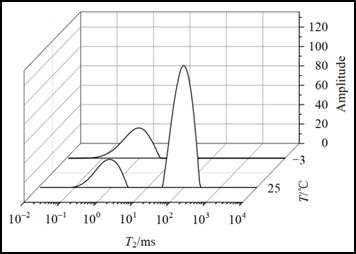
The T2 relaxation times of solid ice and liquid water differ significantly; ice has a T2 of around 6 µs, while bound water in wood is typically in the millisecond range, making them easily distinguishable. NMR analyzers use protons as probes to accurately quantify water content in porous media. By selecting appropriate temperatures, free water in wood cell lumens can be frozen, while bound water remains liquid, allowing precise measurement of bound water signals within the cell walls.
 Scan QR Code
 Scan QR Code
 Phone Support
Phone: 400-060-3233
After-sales: 400-060-3233
 WeChat Support

 Official Account

Back to Top