

Coalbed methane primarily exists in an adsorbed state within coal pores. A clear understanding of the coal’s pore structure and distribution characteristics is essential for evaluating coal reservoir porosity, spatial architecture, permeability features, and methane producibility. Currently, pore structures and pore size distributions in rocks are mainly assessed using capillary pressure curves obtained from mercury intrusion and adsorption-desorption curves from low-temperature nitrogen adsorption experiments. Compared with conventional reservoirs, coal reservoirs are more fragile, highly compressible, structurally complex, and strongly heterogeneous. These traits limit the applicability of conventional methods: for example, low-temperature nitrogen adsorption tests cover a pore size range of 1.7–300 nm, effectively capturing micropores and mesopores but missing macropores and fractures; mercury intrusion is destructive and cannot be repeated. In contrast, low-field nuclear magnetic resonance (LF-NMR) operates on a different principle. It measures the T2 relaxation times of fluids within coal pores to determine the distribution, connectivity, and physical parameters of micropores, mesopores, macropores, and fractures. This technique offers rapid, non-destructive analysis with rich information content.
Low-field NMR Experimental Results
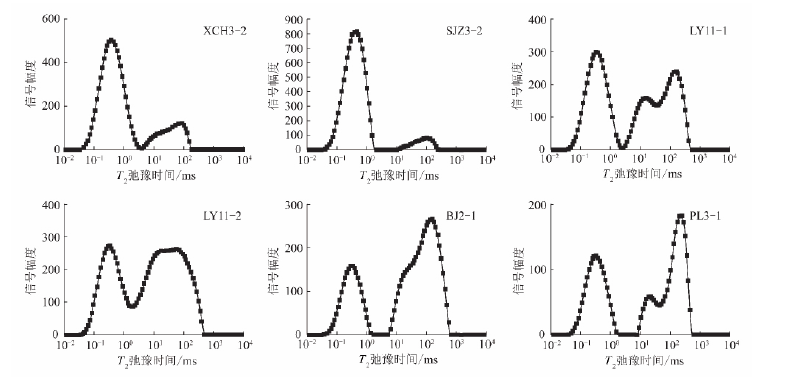
LF-NMR experiments yield the T2 relaxation time spectra of coal samples (Figure 3). Based on the spectral patterns, the samples can be categorised into two main types according to pore size: one type is dominated by micropores, with mesopores, macropores, and fractures poorly developed, typically observed in high-rank coal; the other type features well-developed micropores and macropores or fractures, with relatively undeveloped mesopores, commonly seen in medium-rank coal.
Relationship Between Coal Sample Nitrogen Adsorption/Desorption Curves and Surface Relaxation Rates
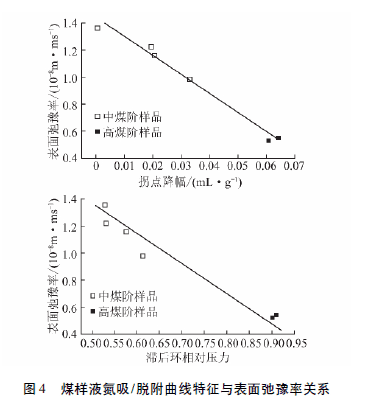
The surface relaxation rate of high-rank coal is significantly lower than that of medium-rank coal. This is primarily due to a higher proportion of micropores, more complex pore structures, and a predominance of “ink-bottle” shaped capillaries in high-rank coal. Consequently, the surface relaxation rate closely correlates with the complexity of the pore structure and the type of pores present.
For more details, please refer to the article: “Low-field NMR Investigation of Micropore Structure in Coal Reservoirs,” Journal of Coal Science, Vol. 40, Supplement 1, June 2015.
 Scan QR Code
 Scan QR Code
 Phone Support
Phone: 400-060-3233
After-sales: 400-060-3233
 WeChat Support

 Official Account

Back to Top