


China is a major aquaculture nation with abundant aquatic resources. Processing fish into surimi products is an effective way to utilize marine resources. Surimi products are rich in protein and carbohydrates and contain a high water content. Improper storage can lead to quality degradation and a shorter shelf life.
Nuclear Magnetic Resonance (NMR) technology offers a non-destructive and rapid method to study water distribution and its states in surimi products during storage at the molecular level, providing a direct visualisation of water content and migration. Internationally, NMR has been applied widely in food processing and storage research.

In meat research, foreign studies have also used NMR technology early on to investigate water in muscle tissue.
During food storage, water content and migration behaviour not only critically affect product quality but also provide essential insights into preservation mechanisms. One of the key steps in surimi production is gelation. The unfolding of α-helical structures at the tail of myosin molecules, combined with hydrophobic interactions, forms internal cross-links and a three-dimensional network. Due to myosin’s strong hydrophilicity, the network traps a large amount of free water. Heat causes this water to become immobilised within the network, creating an elastic gel. During storage, the water entrapped in the gel network undergoes significant changes.
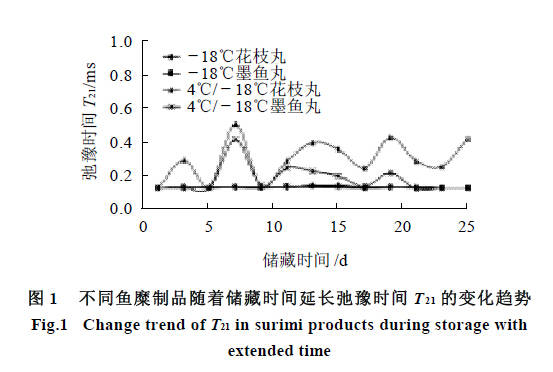
The T21 relaxation time corresponds to water tightly bound to proteins, such as hydrogen-bonded water interacting with amino and carbonyl groups. This water is highly restricted and shows very low mobility.
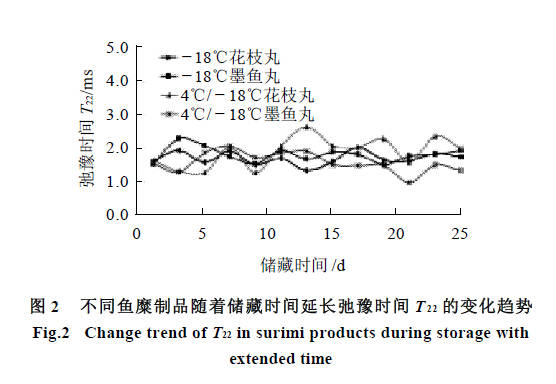
This water shares the same characteristics as T21 water, being tightly bound in surimi products. T22 water, however, is slightly less tightly bound, forming weaker hydrogen bonds with amide groups in proteins and hydroxyl groups in starch or cellulose. Its binding strength is slightly lower than that of single-layer water.
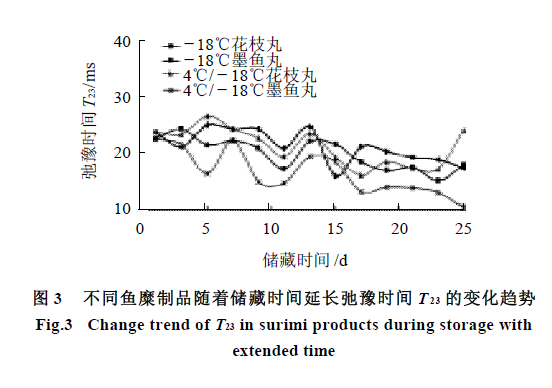
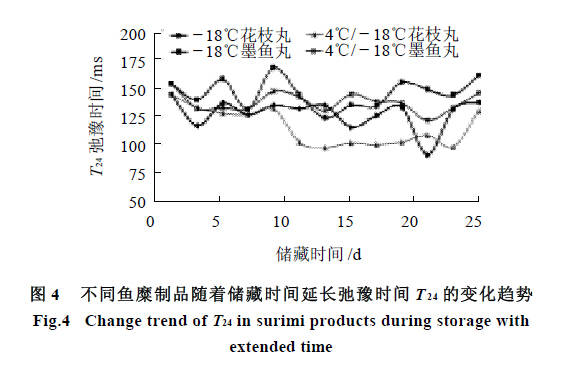
Reference: “Study of Water Changes in Surimi Products During Storage Using NMR” Food Science 2011, Vol. 32, No. 19
For more NMR insights, follow our Mini Program
NMR Research Power Station

 Scan QR Code
 Scan QR Code
 Phone Support
Phone: 400-060-3233
After-sales: 400-060-3233
 WeChat Support

 Official Account

Back to Top