


Polydimethylsiloxane (PDMS) has attracted significant attention in both research and industry due to its exceptional properties and broad range of applications.
Notably, PDMS demonstrates excellent low-temperature resistance, making it uniquely valuable in cold environments. It is commonly used as sealing gaskets for cryogenic storage containers, seals for low-temperature reactors, and enclosures for cryogenic sensors. However, PDMS tends to crystallize rapidly below its melting point (Tm ≈ 228 K), which significantly reduces its elasticity.
In the modification of silicone-based elastomers, the incorporation of fillers is essential to enhance freeze resistance. However, the addition of nanoscale fillers significantly alters the polymer’s structure, dynamics, interaction strength, thermal behavior, and overall performance. Low-field NMR technology enables the evaluation of cold resistance by analysing parameters such as transverse relaxation time (T2) and the relative fractions of free chains and rigid chains as temperature changes.
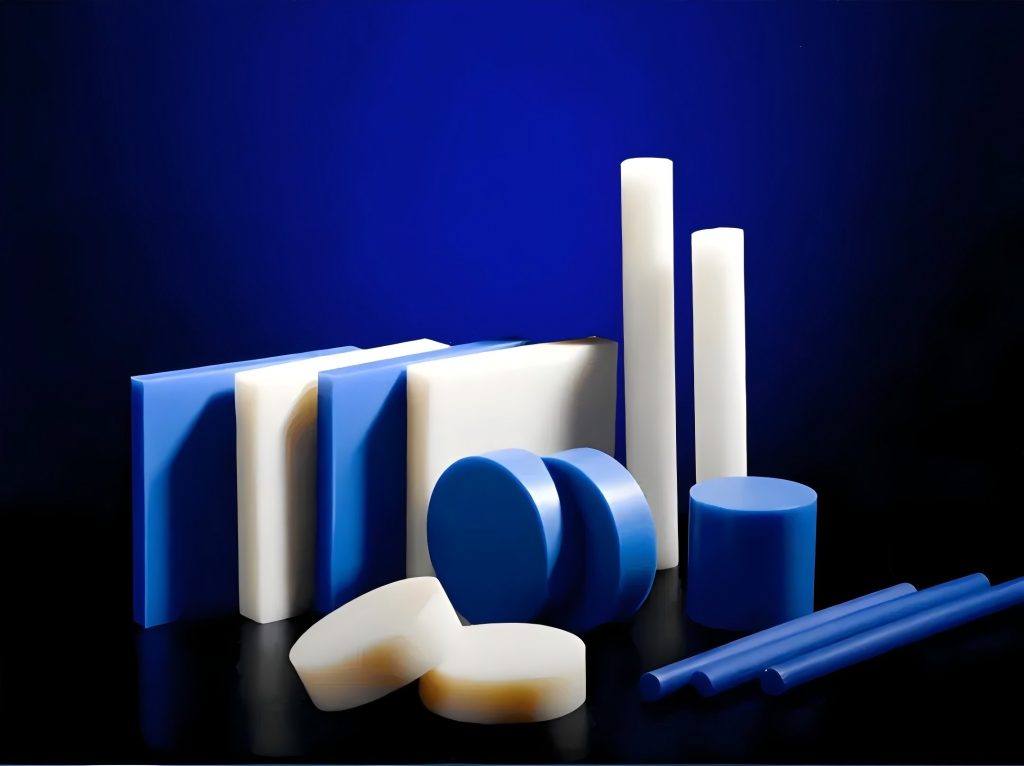
In this application, the authors used a variable temperature low-field NMR system to study relaxation spectra of PDMS (VMQ/SiO2) with varying SiO2 content at different temperatures. The MSE pulse sequence was applied to ensure signal fidelity.
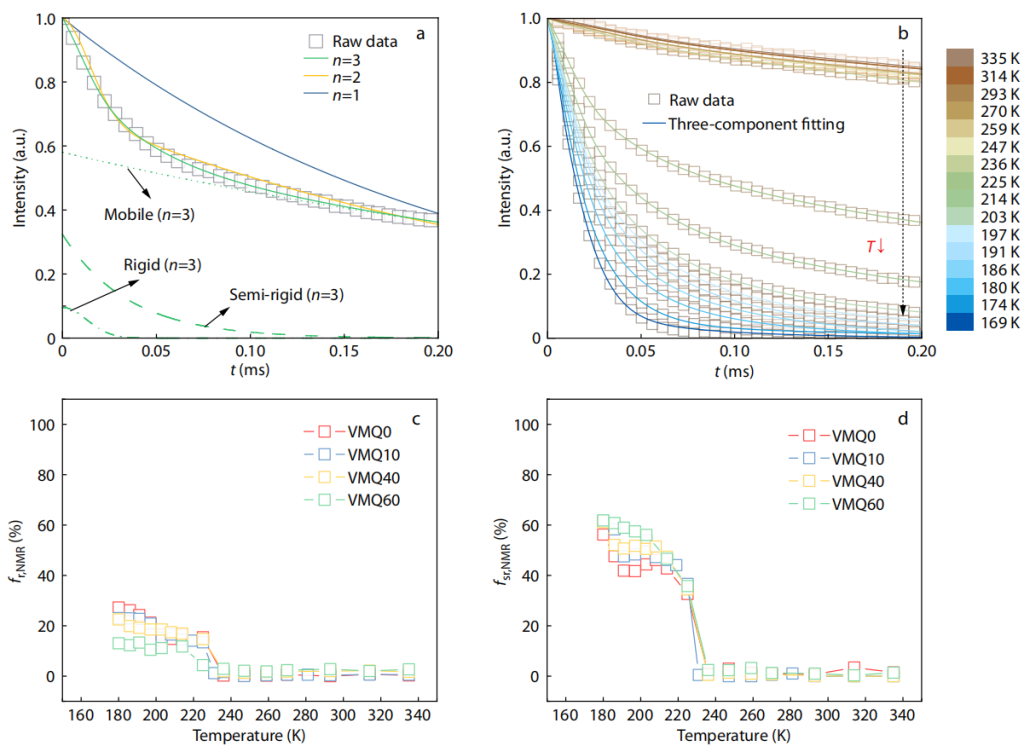
Figure a shows the fitted relaxation curves under low temperatures using a modified Weibull function, with three main components identified: free chains, rigid chains, and semi-rigid chains.
As shown in Figure b, relaxation accelerates with decreasing temperature, indicating that hydrogen proton mobility within the material is strongly temperature dependent. At low temperatures, the rigid components mainly include crystalline domains and tightly bonded interfacial layers formed by chemical crosslinking between polymer chains and filler particles. In contrast, unfilled PDMS only forms rigid domains through crystallization.
Fitting results in Figures c and d reveal a significant increase in rigid chain fraction (frNMR) below the melting point (Tm: 228 K), surpassing 30%. A similar trend is observed in the semi-rigid component at 180 K, with its fraction approaching 60%.
Additionally, Figure c demonstrates that the rigid chain fraction above 228 K decreases as the SiO2 nanoparticle content increases, confirming that nanoparticle incorporation effectively enhances the material’s freeze resistance.
Xiong, Y. Q.; Li, C. L.; Lu, A.; Li, L. B.; Chen, W. Conformational disorder within the crystalline region of silica-filled polydimethylsiloxane: a solid-state NMR study. Chinese J. Polym. Sci. https://doi.org/10.1007/s10118-024-3164-y
If you’re interested in this application, feel free to contact us: 15618820062
 Scan QR Code
 Scan QR Code
 Phone Support
Phone: 400-060-3233
After-sales: 400-060-3233
 WeChat Support

 Official Account

Back to Top