


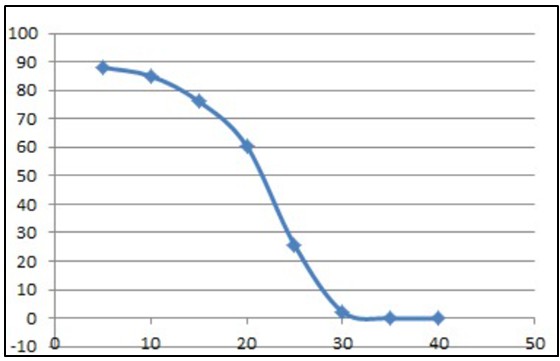
Natural fats at room temperature are generally a mixture of solid and liquid fats. Solid fat content (SFC) is a standard measurement for cocoa butter, margarine, butter, and other fats. It reflects the melting behaviour and hardness of fats at different temperatures, which significantly affects taste, aroma, and spreadability. The NMR Solid Fat Content Analyser allows rapid and accurate determination of the proportion of solid fat. Through calibration and measurement, it collects signals, processes data, and calculates the SFC of the sample.
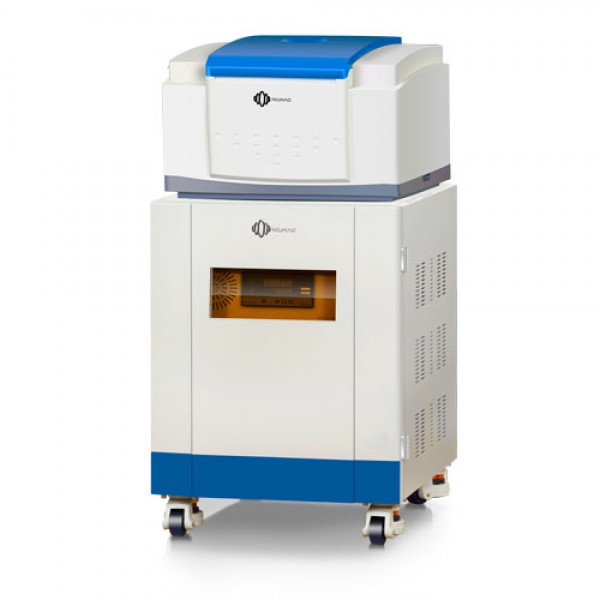
NMR Solid Fat Content Analyser
The hydrogen nuclei (H) in solid and liquid fats exist in different states, causing NMR FID signals to decay very differently. Solid fat signals decay rapidly, typically reaching zero around 70 microseconds. Liquid fat signals decay much more slowly and are essentially unchanged at 70 microseconds.
Because NMR signals from solids decay much faster than those from liquids, measurements can be taken at two points on the FID (Figure 1). The first point, t1 = 11 μs, captures the combined signal of solid and liquid fat, denoted as A1. The second point, t2 = 70 μs, corresponds to the liquid fat signal alone (A2) as the solid fat signal has decayed to zero. By calculation, the solid fat content at a given temperature is determined. Testing at multiple temperatures generates the temperature-dependent solid fat content profile.
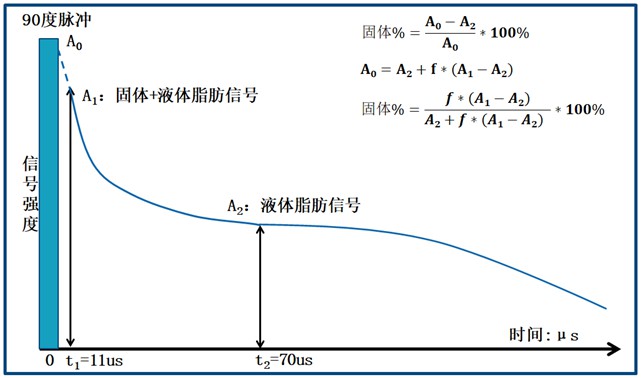
Principle of NMR Solid Fat Content Analysis
1. Perform temperature conditioning according to testing standards;
2. Equilibrate the sample at the specified temperature;
3. Place the equilibrated sample in the instrument to measure the solid fat content;
 Scan QR Code
 Scan QR Code
 Phone Support
Phone: 400-060-3233
After-sales: 400-060-3233
 WeChat Support

 Official Account

Back to Top