


During fiber production, applying an appropriate amount of oiling agent is essential to ensure antistatic properties, bundling behavior, and smoothness—ultimately improving post-processing performance. Uneven oil application may result in issues such as uneven yarn thickness or fuzz. Excess oil leads to unnecessary cost and waste. In spandex production, inaccurate oil content measurements can prevent proper calibration of the degreasing agent (CCl). Since CCl is highly damaging to spandex, it may cause brittleness and a loss of elasticity. Accurate oil content measurement is therefore critical.
Traditional solvent extraction methods take 5–6 hours per test. However, modern chemical fiber production is fast-paced and continuous. Any quality deviation must be corrected immediately. Extraction methods are also costly and rely heavily on chemical reagents and manual labor. In contrast, the NMR method requires only a small sample placed into a probe. The result is available in under a minute. This enhances quality control efficiency—feedback can be delivered to the production line in real time. It reduces testing costs, eliminates harmful solvents, and lowers labor and health risks. Moreover, accurate measurements enable better oil usage control, reducing waste and supporting a greener manufacturing process.
Measurement of fiber oil content
NMR Calibration Curve for Fiber Oil Content
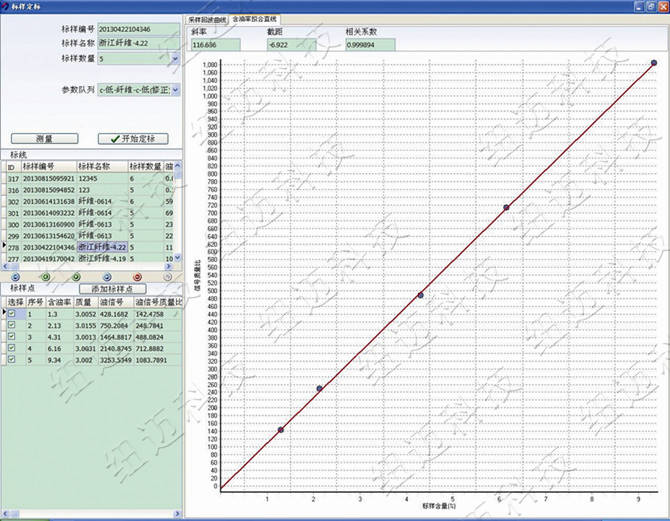
(1) Water–Oil Signature: Use a CPMG sequence to scan one sample and determine its T2 relaxation behavior. Identify oil peaks to help set the correct test parameters.
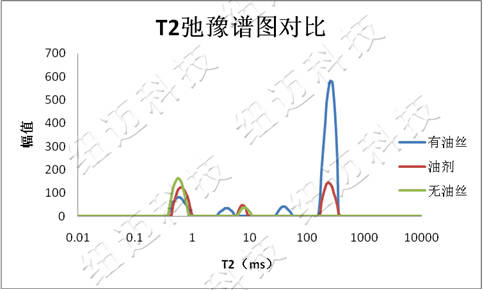
In the T2 spectra of oil-containing, oil-free, and pure oil samples, both fiber and oil signals are visible. The most significant difference appears after 7ms—these later peaks are defined as the oil signal. Peaks before 7ms represent fiber and tube signals. Special NMR sequences can be used to isolate pure oil signals at specific echo times. Therefore, the second echo peak is selected as the oil signal source.
(2) Calibration: Prepare oil-free fibers with varying oil contents. Use the second echo value from the CPMG sequence and plot it against oil content to build a calibration curve (X-axis: oil %, Y-axis: signal per unit mass).
(3) Measurement: Use the fiber oil content software and apply the calibration curve to analyze the unknown sample and calculate its oil content.
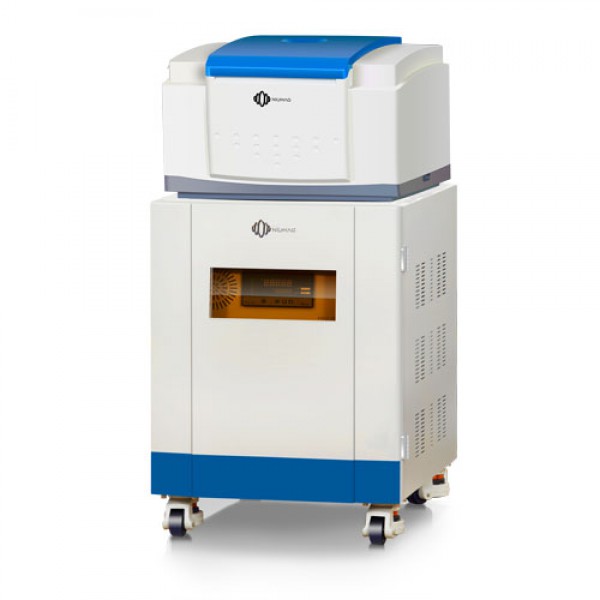
Recommended Instrument: NMR Analyzer for Fiber Oil Content
 Scan QR Code
 Scan QR Code
 Phone Support
Phone: 400-060-3233
After-sales: 400-060-3233
 WeChat Support

 Official Account

Back to Top