


Developing gel materials with tunable friction properties is critical for applications such as soft robotics, anti-fouling surfaces, and joint protection. However, achieving reversible switching between extreme stickiness and slipperiness remains a major challenge due to conflicting energy dissipation requirements at the gel surface. Recently, Prof. Peiyi Wu’s group at Donghua University introduced a self-adaptive bicontinuous fluorogel capable of decoupling lubrication and adhesion across temperature conditions. Their molecular design is illustrated in Figure 1.
Their system uses a copolymer fluorogel composed of 2-perfluorohexylethyl acrylate (PFHEA) and acrylic acid (AA), with perfluoropolyether (PFPE) oligomer as the lubricating solvent. In this gel, PFHEA segments are compatible with PFPE, forming a soft lubricating phase that traps the PFPE lubricant inside the polymer network, generating a thin, self-replenishing lubricating layer at the surface. In contrast, AA segments are incompatible with PFPE and form the supporting phase via multilevel hydrogen bonding.
At room temperature, hydrogen bonding leads to a physically crosslinked network, maintaining a smooth surface enriched with liquid PFPE lubricant (Figure 1c). This results in an extremely low coefficient of friction, even under high shear. Upon heating, hydrogen bonds partially dissociate, reducing modulus and exposing adhesive pendant chains, significantly increasing adhesion. Surprisingly, this strong adhesion remains after cooling, with peel/shear adhesion strength reaching ~3.8 MPa on copper substrates. Moreover, the fluorogel exhibits optical transparency, mechanical strength, antifouling capability, and self-healing—making it a promising candidate for on-demand switchable adhesion-lubrication applications.
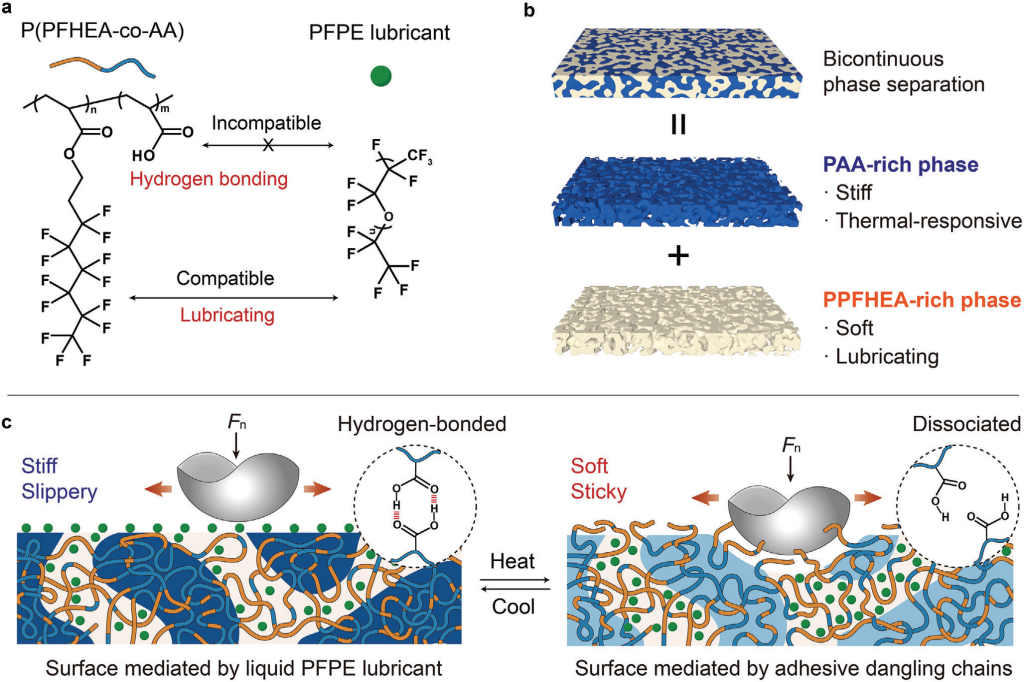
Figure 1: Molecular design and working mechanism of the sticky–slippery switchable fluorogel.
The research team further utilized low-field 19F NMR to analyze the migration and distribution of fluorinated components within the fluorogel (Figure 2). Measurements were performed using the VTMR20-010V-I system from Suzhou Niumag Analytical Instrument Co., Ltd., equipped with a fluorine (F) probe for F signal detection.
In general, a larger T2 value corresponds to higher molecular mobility. In this system, shorter T2 relaxation peaks originate from the fluorinated side chains of PFHEA, while longer peaks correspond to PFPE. As AA content increases, both peaks shift toward shorter relaxation times, indicating reduced chain mobility within the PFHEA/PFPE lubrication phase.
Signal inversion was then used to quantify the proportions of free chains, pendant chains, and crosslinked chains (Figure 3). In pure PFHEA, pendant chains accounted for 39%, but this dropped significantly in the fluorogel. At 50 mol% AA content, crosslinked chains increased significantly. These results clearly demonstrate that increasing AA enhances crosslink density via hydrogen bonding.

Figure 2: 19F NMR spectra at room temperature

Figure 3: Proportions of free, pendant, and crosslinked chains
Taking advantage of the VTMR20-010V-I system’s wide temperature range (–100°C to 250°C), the team also tested the mobility of PFHEA and PFPE segments under thermal cycling (Figure 4). As temperature increased, PFPE mobility rose. Above 80°C, PFHEA signals split into two peaks, with a shoulder peak attributed to pendant chains released via hydrogen bond dissociation between PAA segments.
Importantly, these changes were fully reversible upon cooling, confirming excellent structural reversibility of the fluorogel. Quantitative analysis showed that rising temperature caused only slight reductions in free chains, but a significant increase in pendant chains and a reduction in crosslinked chains. During cooling, all chain populations returned to their original states.
These results demonstrate that strong adhesion at high temperatures is related to pendant chain exposure, while excellent lubrication at room temperature is due to the combination of pendant and crosslinked chains.

Figure 4: T2 spectra and chain composition under temperature cycling
If you’re interested in this application, feel free to contact us: 15618820062
X. Li, B. Wu, S. Sun, P. Wu, Making Sticky–Slippery Switchable Fluorogels Through Self-Adaptive Bicontinuous Phase Separation. Adv. Mater. 2024, 2411273. https://doi.org/10.1002/adma.202411273
 Scan QR Code
 Scan QR Code
 Phone Support
Phone: 400-060-3233
After-sales: 400-060-3233
 WeChat Support

 Official Account

Back to Top