

Time: Saturday, 19 March, 20:00
Topic: Fundamentals of Low-Field NMR and Methods for Characterising Fluid Flow Pathways

Prof. Wei Bing – Live Online
Boost Recovery | Academic Exchange
China holds vast reserves of tight oil, distributed widely, representing a critical replacement resource for domestic petroleum. Enhancing recovery from these tight reservoirs relies on advanced EOR (Enhanced Oil Recovery) techniques. Traditional laboratory methods for EOR in tight oil face limitations due to core property constraints. Nuclear Magnetic Resonance (NMR), a non-destructive, rapid, and accurate analytical tool, offers a novel approach for EOR research. As part of the Seal Plug Society’s public lecture series, we are honoured to feature Prof. Wei Bing from Southwest Petroleum University. Prof. Wei serves as Executive Director of the State Key Laboratory of Oil and Gas Reservoir Geology and Engineering, Director of the Complex Reservoir Tertiary Recovery Research Centre, and leader of the Young Innovation Team on EOR in Complex Reservoirs, with extensive academic contributions in enhanced oil recovery.

Prof. Wei Bing
Southwest Petroleum University, State Key Laboratory of Oil and Gas Reservoir Geology and Engineering
Prof. Wei Bing, PhD supervisor, serves as Executive Director of the State Key Laboratory of Oil and Gas Reservoir Geology and Engineering, Director of the Complex Reservoir Tertiary Recovery Research Centre, and leader of the Young Innovation Team on EOR in Complex Reservoirs. He earned his doctorate from the University of New Brunswick, Canada, and focuses on unconventional reservoir development theory and technology. He teaches Petroleum Engineering undergraduates “Reservoir Physics” and international students in English “Enhanced Oil Recovery.” Using multi-scale experimental simulation and in-situ capture of gas-liquid-solid interfaces, his team has developed methods for tight (shale) reservoir nanoscale confinement, fracture property inversion, matrix/fracture coupled flow, and deep learning-assisted reservoir simulation, with successful applications in the Ordos, Tarim, and Junggar basins. He has led 7 national/provincial research projects and 21 enterprise projects, published 125 papers in journals including SPE J, Petroleum Science, and Energy, and received 7 provincial or national-level awards. Content Summary: Advances in Low-Field NMR for EOR in Tight (Shale) Reservoirs
In 2021, Prof. Wei’s team published a review on NMR applications for enhanced recovery in tight oil in the authoritative journal Energy. Click the image for detailed reference.
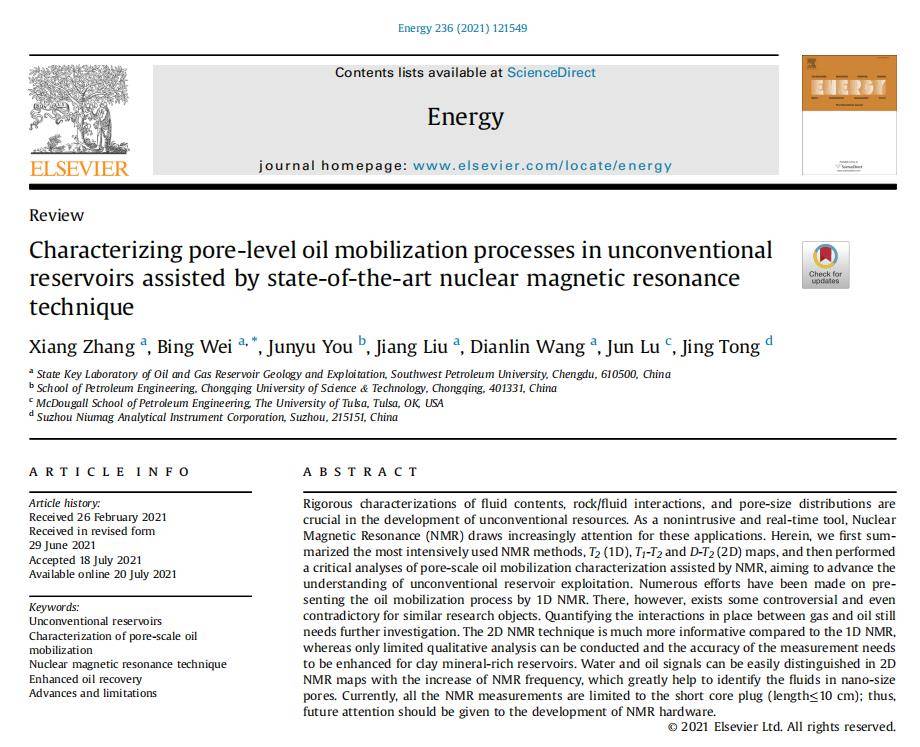
▲Click the image for reference details
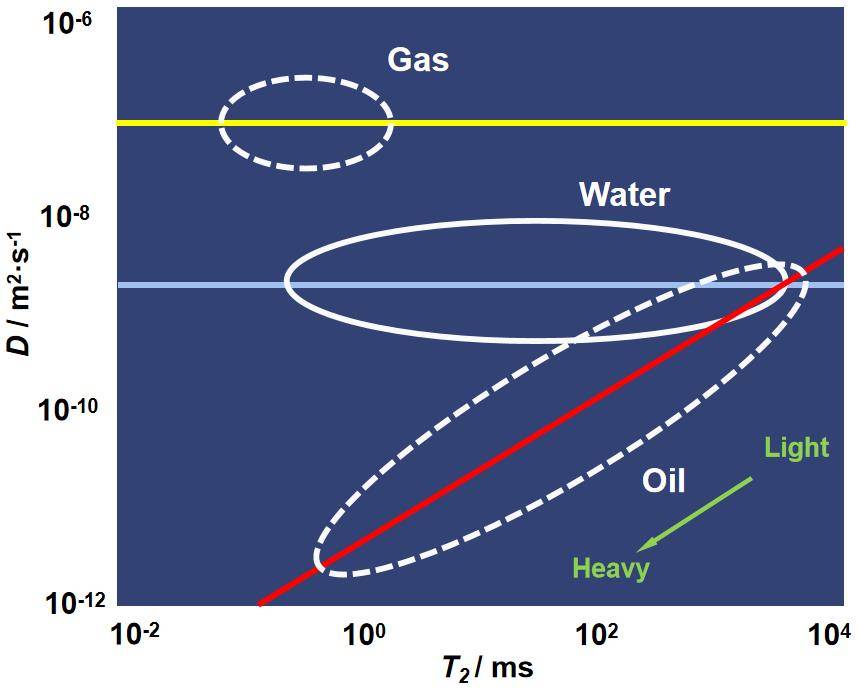
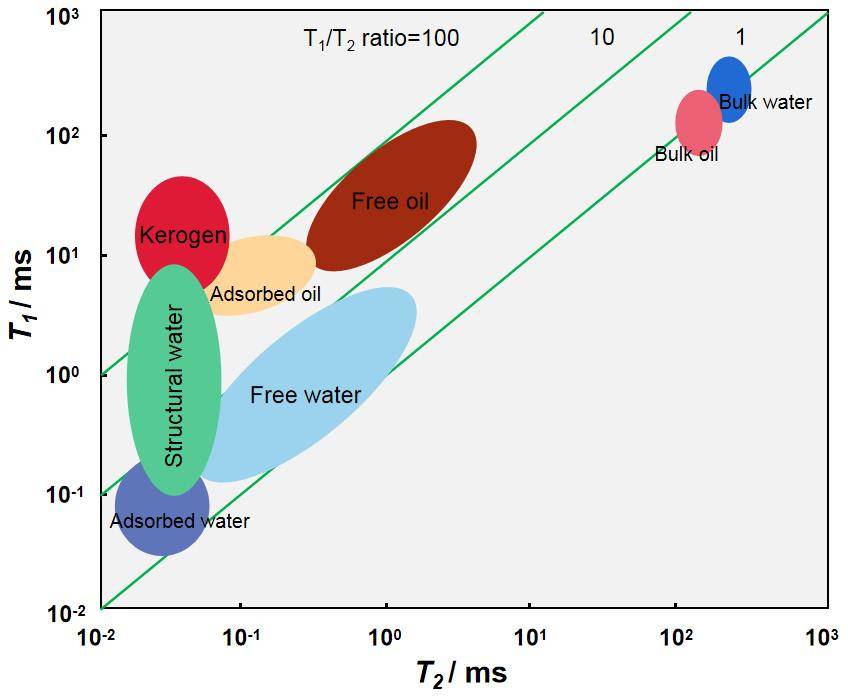
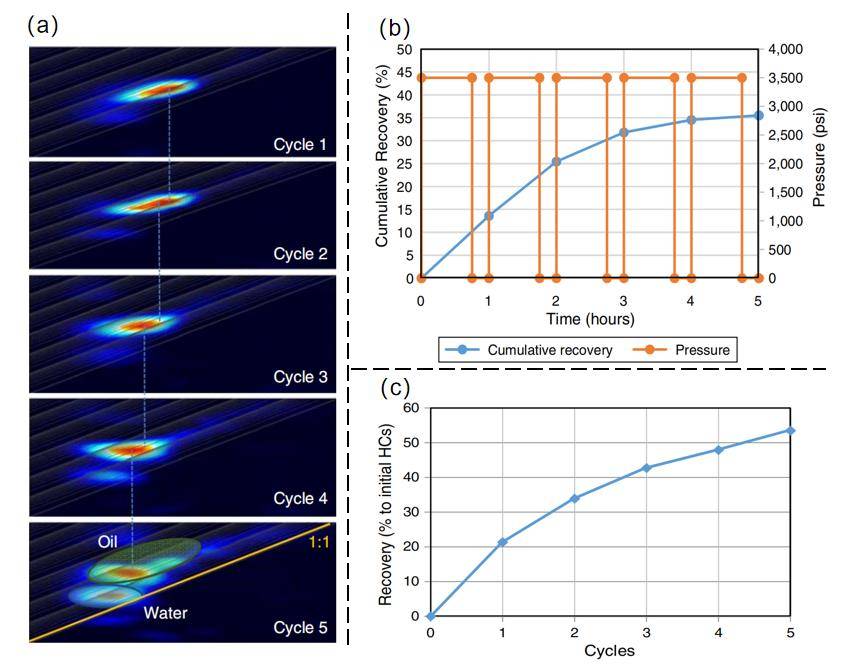

Applications of Low-Field NMR Technology
Journal Articles (First/Corresponding Author, Total Citations: 793)
Characterizing Pore-level Oil Mobilization Processes in Unconventional Reservoirs assisted by State-of-the-Art Nuclear Magnetic Resonance Technique. Energy, 2021. (SCI, EI / IF: 7.147)
Visualization of CO2 Foam Generation, Propagation and Sweep in a Complex 2D Heterogeneous Fracture Network. Fuel, 2021. (SCI, EI / IF: 6.609)
Design and Fabrication of Anionic/Cationic Surfactant Foams Stabilized by Lignin-Cellulose Nanofibrils (LCNFs) for Enhanced Oil Recovery. Energy & Fuels, 2021. (SCI, EI / IF: 3.605)
Effectiveness and sensitivity analysis of solution gas re-injection in Baikouquan tight formation, Mahu sag for enhanced oil recovery. Petroleum, 2020. (SCI, EI / IF: 4.090)
Nuclear Magnetic Resonance (NMR) Monitoring of Mass Exchange in a Low Permeability Matrix-Fracture Model during CO2 Cyclic Injection: A Mechanistic Study. SPE Journal, 2019. (SCI, EI / IF: 3.478)
Nuclear Magnetic Resonance (NMR) Mapping of Remaining Oil Distribution in Sequential Rate Waterflooding Processes for Improving Oil Recovery. Journal of Petroleum Science and Engineering, 2020. (SCI, EI / IF: 4.346)
Colind Wood. Pore-scale Monitoring of CO2 and N2 Flooding Processes in a Tight Formation under Reservoir Conditions using Nuclear Magnetic Resonance (NMR): A Case Study. Fuel, 2019. (SCI, EI / IF: 6.609)
Recent advances of surfactant-stabilized N2/CO2 foams in enhanced oil recovery. Fuel, 2019. (SCI, EI / IF: 6.609)
Prof. Wei Bing’s Team, Southwest Petroleum University
1. David Sinton (Chief Scientist, Canada Energy, Fellow of the Canadian Academy of Engineering, University of Toronto Professor)
“Wei et al. provide a standard method using high-pressure high-temperature phase equilibria apparatus to quantify CO2–crude oil dissolution, diffusion, expansion, and extraction effects.” (Analytical Chemistry, 2018, 90: 2461–2467. Top journal, IF=6.35)

Figure: David Sinton’s evaluation of Prof. Wei’s work
2. Roberto Aguilera (Executive Editor, SPE Journal; Professor, University of Calgary; Chief Scientist, ConocoPhillips Unconventional Reservoirs)
Reviewer comment: This paper is significant for scientific research in the field and provides a better understanding of CO2 EOR mechanisms in tight oil reservoirs. (SPE Journal, 2019, 25, 440–450) I believe this paper can contribute to current knowledge in the field and help the petroleum industry better understand CO2 injection for enhanced oil recovery.
3. Clement Sanchez (Fellow, European Academy of Sciences; Professor, Sorbonne University, Paris; Recipient of the French Materials and Metallurgy Society Award)
“Wei et al. developed a rare foam stabiliser by modifying the surface properties of nanocellulose.” (Chemical Reviews, 2018, 118(24): 11575–11625. Top journal, IF=60.6)
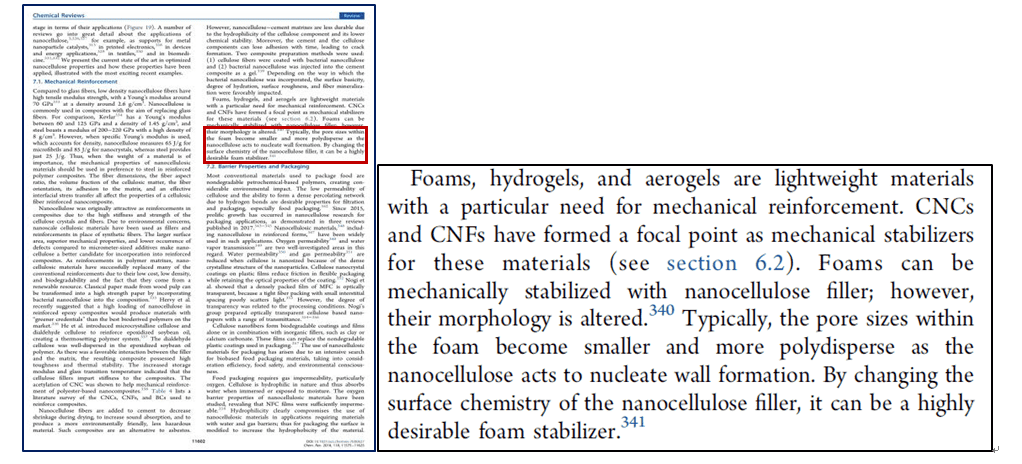
Figure: Clement Sanchez’s evaluation of Prof. Wei’s work
4. Hiroyuki Yano (Professor, Kyoto University, Japan; Fellow, International Academy of Wood Science)
“Wei et al. exploited nanocellulose–surfactant interactions to create foams with strong transport ability, an excellent choice for EOR.” (Advanced Materials, 2020, 2002264. Top journal, IF=30.8)

Figure: Hiroyuki Yano’s evaluation of Prof. Wei’s work
5. Qinglin Wu (Professor, Louisiana State University; Fellow, European Academy of Sciences); Martin Hubbe (Professor, NC State University; Fibre Materials Expert); Michael Bortner (Professor, Virginia Tech; Rheology Expert)
Regarding EOR studies: Of 10 cited papers, 7 are authored by Prof. Wei, demonstrating “depth and continuity in fracture regulation research.” (Advanced Materials, 2021, 33: 2006052. Top journal, IF=30.8)
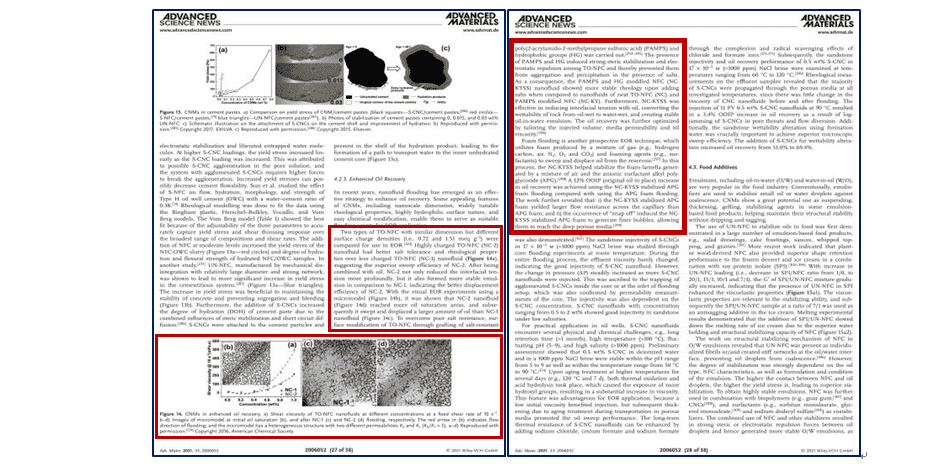
Figure: Qinglin Wu’s evaluation of Prof. Wei’s work
6. Brij Maini (Professor, University of Calgary; CNOOC North America Chief Technology Officer)
“Wei et al.’s nanocellulose offers potential to overcome limitations of HPAM in challenging reservoirs or harsh conditions. Their nanofibre-based system may address bottlenecks for complex reservoirs.” (Advances in Colloid and Interface Science, 2019, 272: 102018. Top journal, IF=9.9)
Visit the Seal Plug Society website at www.sealaplugology.com and search for “Wei Bing” to access the page. Register or log in to watch the live stream immediately.
 Scan QR Code
 Scan QR Code
 Phone Support
Phone: 400-060-3233
After-sales: 400-060-3233
 WeChat Support

 Official Account

Back to Top