

I. Overview of Applications
Moisture is a major component in many foods. Each food has a specific moisture content that is present in a particular amount and spatial distribution, directly influencing the structure, appearance, spoilage sensitivity, and processing characteristics of the food. Among various technologies, nuclear magnetic resonance (NMR) — particularly proton-based NMR — has become one of the most widely studied due to its ability to analyse moisture. As early as the 1950s, the United States began applying NMR to investigate hydration in food systems.
Conventional moisture analysis methods often fail to capture the mobility and distribution of water in food matrices. In contrast, NMR and its imaging counterpart offer a highly effective and non-destructive way to study the diffusion and distribution of water, lipids, and sugars — all of which provide critical structural and environmental information throughout processing and storage. These advantages have led to the widespread adoption of NMR in both academic food science research and industrial quality control systems.
II. Solutions
1. Qualitative Analysis
① Investigate moisture distribution and mobility
② Study water migration during food drying and rehydration
③ Evaluate food preservation, storage, quality, and shelf-life
④ Assess moisture migration during freezing, quick-freezing, and thawing processes
⑤ Explore the impact of inert gas hydrates on food preservation
⑥ Analyse the effects of freezing on food quality
⑦ Determine the freezing point and unfrozen water content in frozen foods
2. Quantitative Analysis
① Moisture content in food products
② Oil content in food products
③ Solid Fat Content (SFC) analysis
④ Glass transition temperature (Tg) determination in food
3. Adulteration Detection
① Detection of gutter oil
② Detection of adulterated milk or honey
③ Differentiation between edible and industrial gelatins
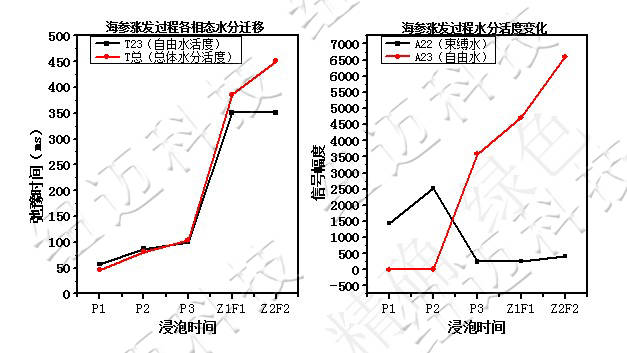
1. Sea Cucumber Rehydration Analysis
During early soaking, external water enters the sea cucumber and becomes intracellular water, increasing the bound water (A22) content. As soaking continues, the internal structure expands and A22 gradually migrates to free water (A23). The overall water activity in the sea cucumber increases as rehydration progresses.
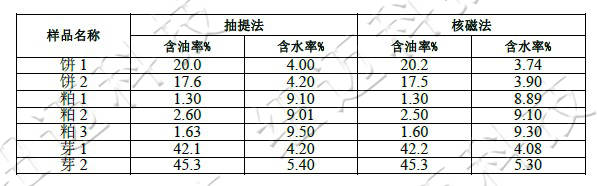
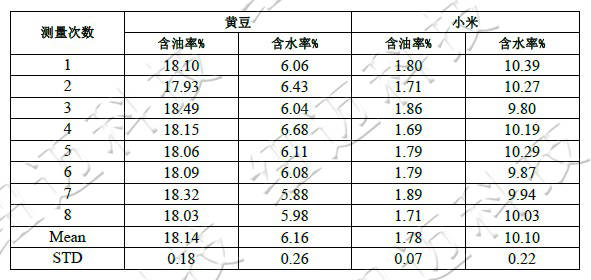
2. Comparison of Moisture and Oil Content in Foods
· Accuracy: Deviation less than 0.5%
· Repeatability: Standard deviation less than 0.1%
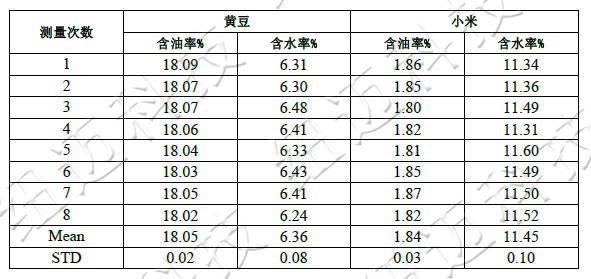
· Stability: Standard deviation less than 0.5%
 Scan QR Code
 Scan QR Code
 Phone Support
Phone: 400-060-3233
After-sales: 400-060-3233
 WeChat Support

 Official Account

Back to Top