


Da Pingding jujube, also known as Pingding jujube, has a sweet-and-slightly-tart flavour, crisp and refreshing texture, and rich nutritional value. It is primarily grown in Chaoyang County and the suburbs of Chaoyang City in western Liaoning Province. This variety is highly resilient, with stable and abundant yields, making it an excellent choice among Chaoyang jujubes. However, fresh Da Pingding jujubes are challenging to store; at room temperature, their crispness lasts only a few days, and the fruit easily loses water, wrinkles, rots, or softens. Once the flesh softens and juice is lost, the quality as a fresh food drops significantly. The water content and state in fresh fruits and vegetables greatly influence their quality and susceptibility to spoilage. Studying water content and its distribution and migration in fruits and vegetables is therefore vital for storage and preservation. Nuclear magnetic resonance (NMR) and imaging techniques provide an effective method for analysing diffusion and can be applied to investigate water distribution and migration in food systems. The characteristics of NMR make it particularly advantageous for food science research, especially for fresh agricultural products.
The effect of calcium treatment on water distribution in Da Pingding jujubes: water in the fruit can be categorised into three types—bound water, semi-bound water, and free water. These correspond to T2 relaxation values in the inversion spectrum as follows: T21 (0.1–10 ms), T22 (10–200 ms), and T23 (200–1000 ms), respectively.
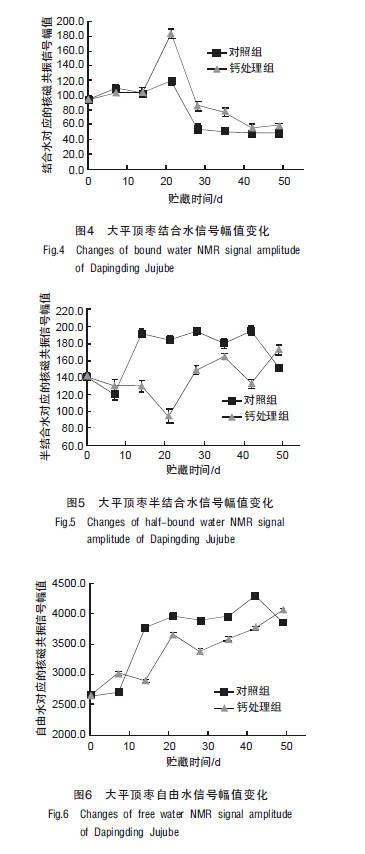
The image above shows water content changes before and after calcium treatment
NMR T2 relaxation measurements indicate that water in Da Pingding jujubes exists in three forms: bound water, semi-bound water, and free water. Using MRI systems to examine the water distribution and relative content allows differentiation between jujubes of varying freshness.
For further details, please refer to the publication: “Study of the Effect of Calcium Treatment on the Preservation of Da Pingding Jujubes Using Low-Field Nuclear Magnetic Resonance Technology,” Food and Fermentation Technology, 2014, Issue 2.
 Scan QR Code
 Scan QR Code
 Phone Support
Phone: 400-060-3233
After-sales: 400-060-3233
 WeChat Support

 Official Account

Back to Top