


China’s proven shale gas geological reserves reach as high as 544.129 billion cubic metres, making recoverable reserves among the largest in the world. Gas injection displacement technologies for coal seams, shale and tight gas are important measures to enhance recovery of the three gases, strengthen underground gas extraction, and prevent outbursts. These techniques not only create economic value and improve mine safety but also enable sequestration of greenhouse gases such as CO₂, offering substantial practical value. Nuclear magnetic resonance (NMR) is a non-invasive, online technique that enables precise, microscopic quantification of adsorption–desorption characteristics of gas in coal-bearing shales.
Basic principle of low-field NMR for studying competitive adsorption among methane, carbon dioxide and nitrogen:
NMR detects the hydrogen (¹H) content and distribution in samples — CH₄ contains hydrogen and therefore produces an NMR signal, whereas CO₂ and N₂ contain no hydrogen nuclei and do not generate an NMR signal. When the gas content or state within coal changes, variations in the CH₄ signal on the T₂ spectrum reveal those changes. By analysing the CH₄ T₂ signal, we can infer competitive adsorption relationships and their evolution among different gases.
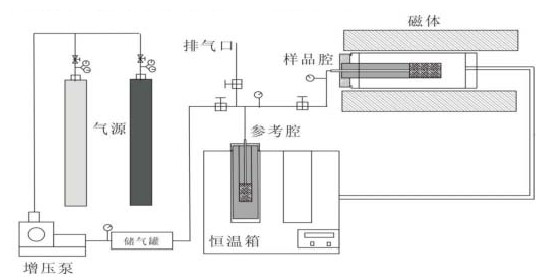
Apparatus diagram for low-field NMR studies of competitive adsorption between methane, carbon dioxide and nitrogen:
Conclusions from low-field NMR studies of competitive adsorption between methane, carbon dioxide and nitrogen:
(1) NMR technology can detect the ¹H content and distribution associated with CH₄ in coal samples. Since CO₂ contains no hydrogen nuclei, the CO₂–coal competitive adsorption process can be effectively characterised by NMR signals.
(2) Analysis of T₂ spectral area and changes in injection pressure shows that, as adsorption time and injection pressure increase, the adsorption rate of coal for gases gradually decreases. When multiple gases are injected, the more strongly adsorbing gas exhibits a higher adsorption rate in the coal.
(3) Competitive adsorption relationships among gases can be demonstrated by gas displacement experiments: a strongly adsorbing gas displaces weakly adsorbing gas first from large pores and then progressively from smaller pores. Conversely, weakly adsorbing gases do not effectively displace strongly adsorbed gases from coal.
(4) Injecting a weakly adsorbing gas into coal already containing a strongly adsorbed gas results in a small amount of adsorption of the weakly adsorbing gas; adsorption increases with pressure.

Reference: [1] Luo Mingkun, Li Sheng, Rong Hai, et al. An NMR experimental study on competitive adsorption relationships among CH₄, N₂ and CO₂. Journal of China Coal Society, 2018, 43(2): 8.
 Scan QR Code
 Scan QR Code
 Phone Support
Phone: 400-060-3233
After-sales: 400-060-3233
 WeChat Support

 Official Account

Back to Top