


In the production of flexible substrates for electronic devices, conductive inks are applied to coat circuit patterns on the substrate—enhancing both flexibility and conductivity.
With continued upgrades in electronics performance and the proven advantages of nanomaterials, adding advanced components such as polyvinylpyrrolidone (PVP), copper nanoparticles, and indium tin oxide (ITO) nanoparticles into ink formulations can significantly improve substrate flexibility and conductivity. The dispersion stability of these materials in the ink plays a critical role in final product performance.
So, what parameters can low-field NMR provide to evaluate particle dispersion in conductive inks?

Inks offer low cost, low sintering temperatures, and high post-sintering conductivity—making them a promising solution for printing electronic circuits on flexible substrates.
In practice, inks are deposited onto substrates via printing, followed by sintering using thermal or photonic methods to form highly conductive thin films. However, with repeated bending and use, the sintered films may develop cracks, leading to a sharp rise in resistivity. These cracks are the primary cause of performance degradation due to mechanical deformation.
To minimize resistivity increases, researchers can optimize nanoparticle properties or enhance dispersion using additives such as dispersants. Two notable approaches include:
1. Synthesizing surface-textured indium tin oxide (ITO) nanoparticles via solvothermal methods under high indium and chloride ion concentrations. The protrusions on the ITO surface increase hydrophilicity and surface area. These particles exhibit excellent dispersion in solvents—even without any dispersant—making them ideal for creating transparent conductive films on flexible substrates.
2. Using polyvinylpyrrolidone (PVP) as a dispersant to improve the dispersion of copper nanoparticles in ink. Low-resistivity sintered films are then formed on polyimide (PI) substrates. Combining copper nanoparticles with copper nanowires further enhances conductivity and flexibility. The uniform dispersion of PVP in ink is essential for forming cohesive and flexible films, which significantly delays crack initiation and propagation—delivering excellent performance.
Evaluating the dispersion performance of these modified nanomaterials, as well as the effect of different dispersant concentrations, requires a scientific and quantitative analytical approach.
Low-field NMR is a rapidly maturing solution for dispersion analysis—offering fast, online, non-destructive, and eco-friendly benefits.
Low-field NMR is used to study how different concentrations of PVP affect the dispersion of copper nanoparticles in conductive inks.
Sample System: Copper nanoparticles (dispersed phase), PVP (dispersant).
Dispersing medium: Copper nanoparticles and PVP material.
Solvent: Ethanol.
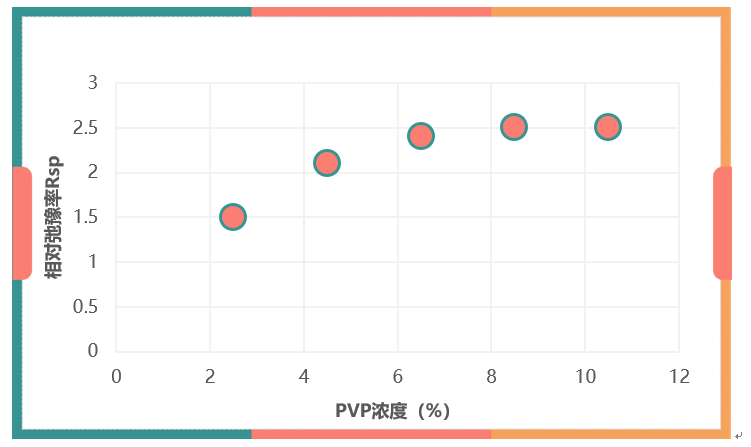
Based on the test results, as PVP concentration increases, the dispersion of copper nanoparticles (as indicated by relative relaxation rate) improves. Once PVP reaches a certain threshold, dispersion performance stabilizes. Low-field NMR is thus an effective tool to help determine the optimal dispersant concentration in formulation development—empowering industrial production with data-driven decisions.
Beyond semiconductor CMP slurries, low-field NMR is also ideal for analyzing the dispersion and stability of advanced materials in high-growth industries—including new energy battery slurries, conductive silver paste in photovoltaics, graphene suspensions, and electronic inks.
 Scan QR Code
 Scan QR Code
 Phone Support
Phone: 400-060-3233
After-sales: 400-060-3233
 WeChat Support

 Official Account

Back to Top