

Magnetic resonance (MR), as a powerful imaging modality, has been widely applied in the diagnosis of a wide spectrum of diseases due to its non-radiative nature and excellent resolution, particularly for soft tissues. However, conventional clinical contrast agents (e.g., Magnevist) suffer from rapid clearance, poor targeting, and potential risks such as nephrogenic systemic fibrosis. With the rapid development of nanotechnology, a variety of nanoparticles have been developed. By tuning their size and surface functionalisation, these nanoparticles can address many of the above limitations. Nevertheless, most current nanoparticle synthesis still relies on traditional chemical methods, which are often complex, poorly reproducible, and environmentally unfriendly. Therefore, developing a green, biocompatible, highly reproducible strategy for preparing high-performance MR contrast agents has become increasingly important.
In this study, we employed a protein-mediated biomimetic strategy to prepare Gd:CuS@BSA nanoparticles as contrast agents. This method offers several advantages: mild reaction conditions (37 °C) with direct aqueous-phase synthesis; green chemistry without toxic organic solvents; high reproducibility and scalability; and nanoparticles with excellent biocompatibility and stability. Following preparation, we evaluated their relaxivity and both in vitro and in vivo contrast-enhancing performance.
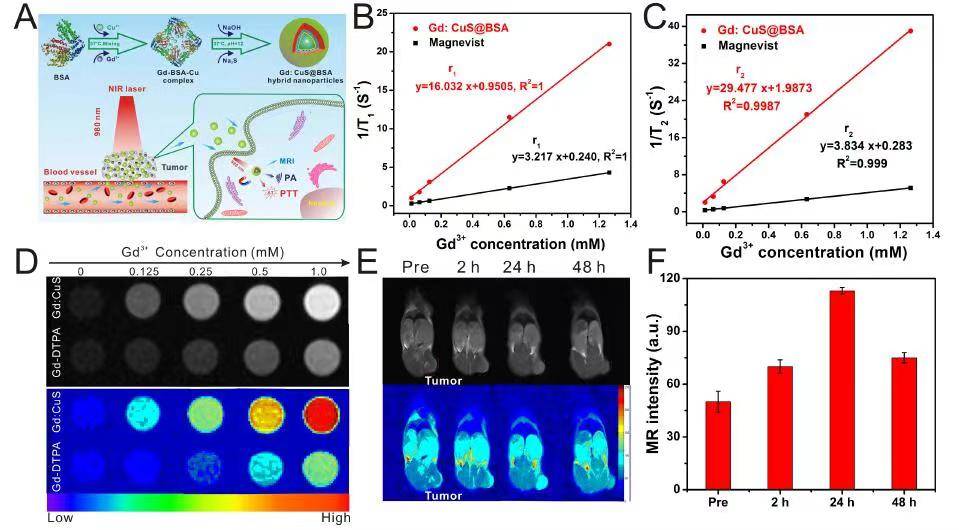
(A) Schematic of Gd:CuS nanoparticle synthesis; (B) longitudinal relaxation curve; (C) transverse relaxation curve; (D) in vitro T1-weighted imaging; (E) in vivo T1-weighted imaging; (F) signal intensity values.
Using a protein-mediated biomimetic strategy, we successfully prepared a high-performance T1-weighted MRI contrast agent, Gd:CuS. The maximum longitudinal relaxivity achieved was 16 mM−1s−1.
The nanoparticles also exhibited excellent water solubility, biocompatibility, and tumour-targeting properties, providing a novel approach for developing next-generation contrast agents.
Note: This work has been published in the international journal ACS Nano, impact factor 13.942 [ACS Nano, 2016, 10(11): 10245–10257].
Selected from the Niumag Case Competition: YANG Weitao, ZHANG Bingbo* (Institute of Biomedical Engineering & Nanoscience, Tongji University; School of Medicine, Tongji University).
 Scan QR Code
 Scan QR Code
 Phone Support
Phone: 400-060-3233
After-sales: 400-060-3233
 WeChat Support
 Official Account
Back to Top