


With the advancement of enhanced oil recovery (EOR) technologies, gas flooding — particularly CO₂ miscible flooding — is emerging as a highly promising method to improve recovery rates in China’s low-permeability reservoirs. This article introduces the use of low-field NMR to study CO₂ miscible flooding. First, let’s understand the mechanism behind CO₂ miscible flooding.
Mechanism of CO₂ Miscible Flooding
Miscible flooding occurs under reservoir high-temperature conditions, where light hydrocarbon molecules in crude oil are extracted into the CO₂-rich gas phase, forming two states: a gas phase enriched with light hydrocarbons and a liquid phase (crude oil) dissolved with CO₂.
The CO₂ miscible flooding mechanism can be summarised in three main aspects:
(1) At sufficiently high pressures, CO₂ extracts light components from crude oil, reducing the oil’s capacity to dissolve asphaltenes and waxes. Heavy components precipitate, significantly lowering oil viscosity, enhancing flow, and achieving the goal of CO₂ miscible flooding.
(2) CO₂ has high solubility in reservoir oil, which aids oil expansion, utilising the oil’s elastic expansion energy to push fluids toward the wellbore.
(3) The interaction between oil and CO₂ reduces the interfacial tension of crude oil. The interfacial tension of the oil–CO₂ system decreases rapidly with increasing pressure.
Using high-temperature, high-pressure low-field NMR online characterisation technology, the NMR signal during CO₂ cyclic injection in fractured tight sandstone can be monitored in real time. This allows pore-scale observation of mass exchange between rock matrix and fractures (i.e., crude oil flow paths), enabling detailed investigation of CO₂ miscible flooding mechanisms and the process by which CO₂ injection enhances oil recovery in fractured tight reservoirs.
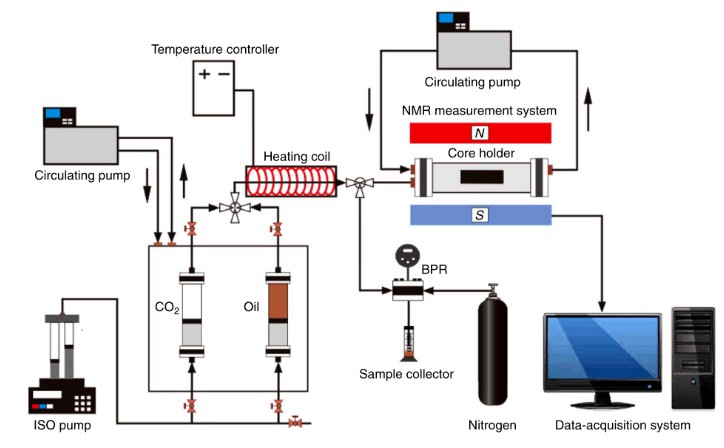
CO₂ Miscible Flooding Mechanism: Schematic of NMR online monitoring setup for cyclic CO₂ injection in fractured tight sandstone
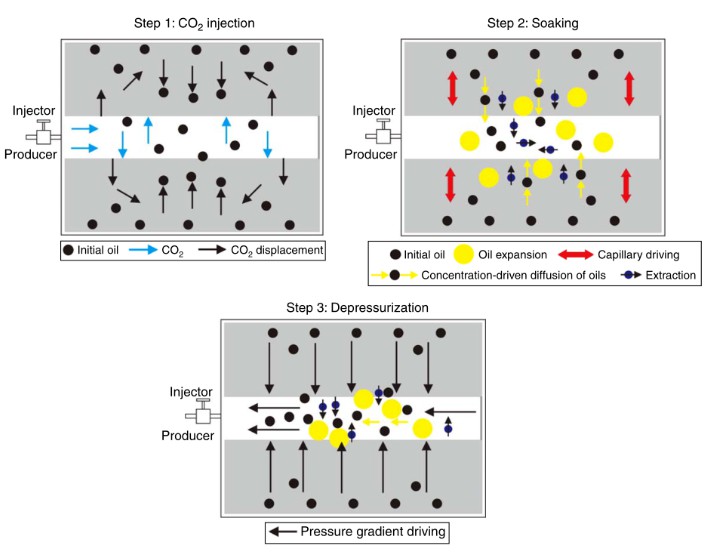
CO₂ Miscible Flooding Mechanism: Schematic of mass exchange between rock matrix and fractures
CO₂ miscible flooding mechanisms and the resulting enhancement in oil recovery are primarily controlled by three factors: the displacement effect of CO₂, interactions between CO₂ and crude oil (mainly extraction and dissolution), and pressure drop effects. The three-stage process of CO₂-enhanced recovery and associated mass exchange between matrix and fractures can be summarised as follows:
Injection stage: Injected CO₂ advances through fractures, rapidly increasing the core system pressure to 35 MPa. Due to internal pressure gradients, CO₂ efficiently displaces oil near the fractures.
Soaking stage: During this stage, CO₂ further diffuses into the rock matrix and dissolves in the matrix oil. Extraction and dissolution dominate, with local high pressures created by dissolved CO₂ pushing oil toward the fractures.
Pressure drop stage: As system pressure decreases, oil from fractures and adjacent matrix zones is transported to the production well under the influence of the pressure gradient.
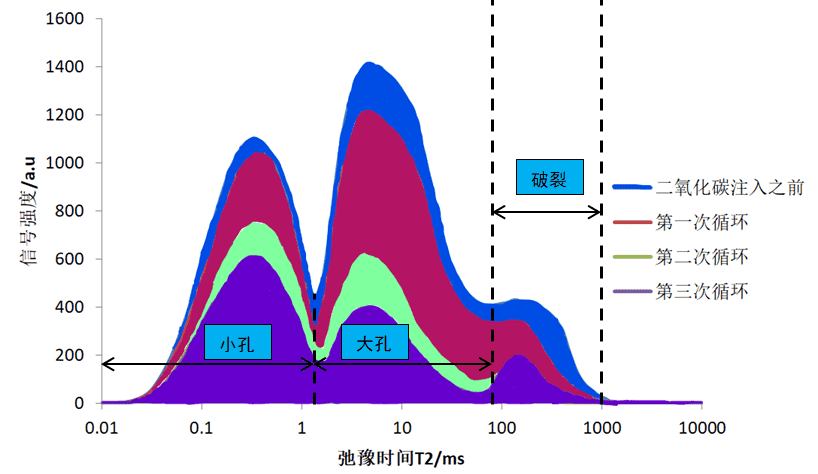
CO₂ Miscible Flooding Mechanism: T₂ spectral characteristics of core during cyclic CO₂ injection
 Scan QR Code
 Scan QR Code
 Phone Support
Phone: 400-060-3233
After-sales: 400-060-3233
 WeChat Support

 Official Account

Back to Top