


With the rise of functional foods, food scientists and nutritionists have developed products offering specific health benefits, such as lowering glycaemic index, supporting weight management, or improving skin health. One key aspect is personalised nutrition, which requires foods designed to optimise nutrient absorption based on individual needs. Achieving this demands a deep understanding of protein behaviour within the human digestive system, including its breakdown in the stomach.

Artificial gastric fluids are commonly used to simulate stomach conditions in vitro. The pharmacopeia recommends: “Take 16.4 ml of dilute hydrochloric acid, add about 800 ml of water and 10 g of pepsin, mix well, then dilute with water to 1000 ml.”[1] In food science and nutrition, the artificial gastric fluid is designed to better reflect physiological reality, often using biomimetic simulators or mimicking the gastric fluid composition.[2] Besides HCl and pepsin, other components such as gastric mucin or food matrices are included to more accurately replicate digestive conditions in the stomach.
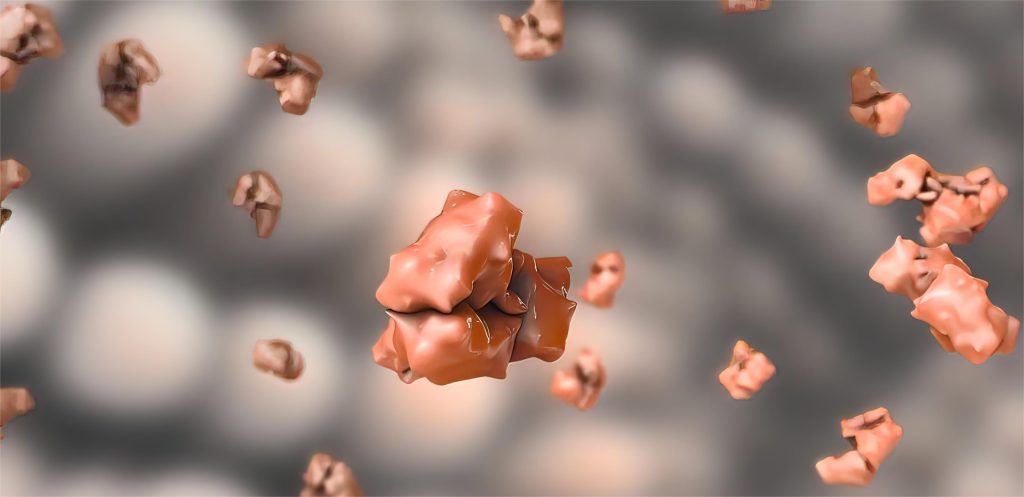
In some digestive studies, for example, when exogenous substances are added to proteins[3] or complex hydrogel encapsulation systems are constructed[4], low-field NMR has been employed to characterise different water populations (free water, loosely bound water, and tightly bound water) within digested substances, providing classic insights into water distribution and migration in food matrices.
Similar to the principle of relaxation rates used in contrast agents, the relaxation rates in artificial gastric fluid are influenced by the chemical environment and physical dynamics of water protons in the sample, primarily reflecting interactions between proteins and water, and the effect of pH on proton dynamics. By measuring relaxation rates (R1 and R2) and correlating them with protein concentration and hydrogen ion concentration ([H+], reflecting pH), a mathematical model can be developed to predict the extent of protein digestion under different gastric pH conditions.
Experimental Procedure:
1. Sample preparation. Prepare two concentrations of whey protein isolate (WPI) gels, 15 wt% and 20 wt%, and immerse them in standard simulated gastric fluid (pH 1.5, 37°C).
2. Data collection. Record measurements at selected time points: before digestion (t=0 min), every 5 min during the first 30 min, and every 30 min from 30 min to 120 min. Measure sample pH with a pH meter and protein concentration using a BCA assay kit. Relaxation rate measurement: use the CPMG sequence to determine T2, and the CWFP sequence[5] for T1. Compute R2 = 1/T2 and R1 = 1/T1.
Experimental Results:
Linear regression analysis was performed to establish empirical equations relating R1 and R2 to protein concentration and [H+] (pH).
R2 = 0.46 + 0.05 · c_protein − 1.31 · c_protein·[H+] (R² = 0.99)
R1 = 0.41 + 0.006 · c_protein − 0.02 · c_protein·[H+] (R² = 0.96)
This study introduces a novel approach for developing functional foods for populations with impaired digestive function (e.g., hypo- or hyper-gastric acid secretion). By using empirical equations based on relaxation rates, protein concentration, and pH, it is possible to personalise intake or formulate products tailored to achieve precise nutrition.
If you are interested in the above applications, please contact: 15618820062
[1] Pharmacopoeia of the People’s Republic of China, 2020 edition, Volume IV, 0921 Disintegration Time Test, Notes.
[2] Deng, R., Seimys, A., Mars, M., Janssen, A. E. M., & Smeets, P. A. M. (2022). Monitoring pH and whey protein digestion by TD-NMR and MRI in a novel semi-dynamic in vitro gastric simulator (MR-GAS). Food Hydrocolloids, 125, 107393.
[3] Liu Xiaoyan, Ye Yuehua, Bai Weidong, et al. Effect of exogenous substances on conformation and in vitro digestion of low-salt tilapia surimi protein [J]. Food Science & Technology, 2024, 45(1): 80−87.
[4] Liu Zhiqin, Chen Junliang, Ren Guangyue, et al. Construction and mechanism of gelatin/sodium hexametaphosphate/glutamine transaminase composite hydrogel encapsulation system [J]. Food Science, 2023, 44(16): 81-90.
[5] Fabíola Manhas Verbi Pereira, Sérgio Bertelli Pflanzer, Thaísa Gomig, Carolina Lugnani Gomes, Pedro Eduardo de Felício, Luiz Alberto Colnago, Fast determination of beef quality parameters with time-domain nuclear magnetic resonance spectroscopy and chemometrics, Talanta, Volume 108, 2013, Pages 88-91, ISSN 0039-9140.
 Scan QR Code
 Scan QR Code
 Phone Support
Phone: 400-060-3233
After-sales: 400-060-3233
 WeChat Support

 Official Account

Back to Top