

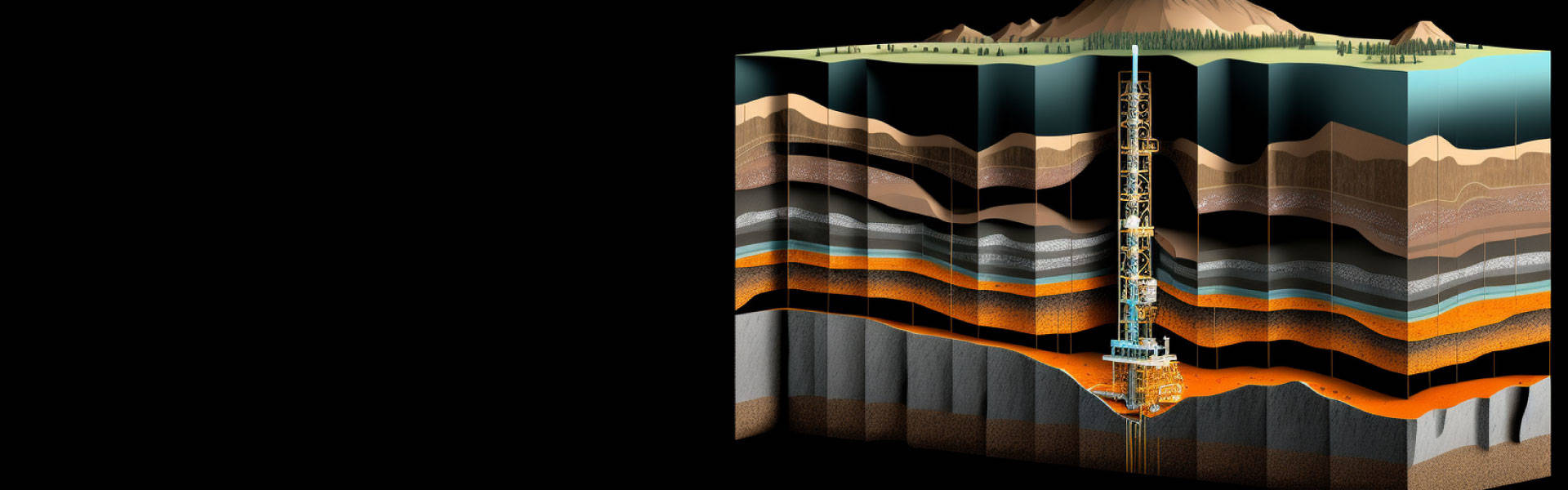
Introduction: Research shows that throughout a person’s lifetime, daily necessities such as clothing, food, housing, and transportation consume up to 8,469 kg of petroleum. As a critical strategic mineral resource, oil and gas not only underpin everyday life but also hold immense significance for economic development. After over a century of extraction, the development of oil and gas resources has become increasingly challenging. Exploration targets have shifted from conventional to unconventional, from onshore to offshore, and from shallow to deep waters, demanding ever more advanced technologies and equipment. How can more oil and gas resources be unlocked? How can reservoir enhancement and protection be effectively evaluated? As an advanced analytical technique, what role can nuclear magnetic resonance (NMR) play in this context? To answer these questions, Instrument Info recently interviewed Professor Tang Hongming from the State Key Laboratory of Oil and Gas Reservoir Geology and Development Engineering at Southwest Petroleum University, and Dr. Lai Jie from the research team led by Vice President Professor Guo Jianchun of Southwest Petroleum University.
Using Low-Field NMR for a Comprehensive “Diagnosis” of Oil and Gas Reservoirs
An oil and gas reservoir is the basic unit where hydrocarbons accumulate within the crust. Petroleum and natural gas that we use are typically extracted from these traps, which act as natural “warehouses” storing oil and gas. Reservoirs can be classified as conventional or unconventional. In recent years, with the ongoing discovery and study of unconventional oil and gas, traditional petroleum geology theories and methods based on conventional reservoirs have increasingly struggled to meet the demands of modern exploration. Consequently, many researchers are now focusing on unconventional reservoirs such as tight oil and shale gas—a key research area for Professor Tang Hongming.
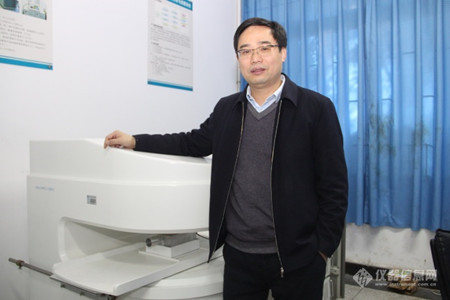
Professor Tang Hongming, Southwest Petroleum University
Professor Tang Hongming is a professor at Southwest Petroleum University and a part-time researcher at the State Key Laboratory of Oil and Gas Reservoir Geology and Development Engineering. He is also a reserve candidate for the academic and technical leadership in Sichuan Province. His research focuses on reservoir damage mechanisms and protection techniques, evaluation of unconventional reservoirs, and development geology. Since 2000, Professor Tang has led or participated in five projects funded by the National Natural Science Foundation, three major national oil and gas projects, and one National High-Tech Research and Development Program (863 Program). His work, including “Engineering Theory, Methods, and Applications for Shale Gas Development in the Southern Sichuan Marine Formation,” has received a first-class provincial and ministerial award, while other projects, such as “Research and Application of Produced Water Re-injection Technology in Offshore Oilfields,” have won four second-class provincial and ministerial awards. He holds 10 authorised invention patents and has published over 150 academic papers, including nearly 20 in SCI journals.
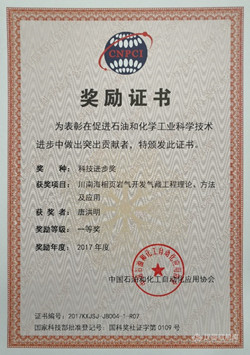
First-Class Provincial and Ministerial Science and Technology Progress Award
Reservoir protection technology is one of Professor Tang’s primary research areas. This systematic engineering approach requires implementing protection measures throughout all stages—from drilling to field depletion. The core objective is to use various techniques to maintain or enhance reservoir permeability, enabling efficient, sustained, and scientific development of reservoirs, reducing costs, prolonging the life of oil and gas fields, and maximising recovery rates. According to Professor Tang, pioneers such as former Southwest Petroleum College President Zhang Shaohuai and Academician Luo Pingya laid the foundation for this technology. Thanks to the dedicated work and knowledge transfer of successive scholars, reservoir protection has become a traditional strength of Southwest Petroleum University, maintaining a leading position both domestically and internationally.
Inspired by these senior experts and driven by curiosity about his research direction, he joined the reservoir protection research team upon graduating in 1989, launching a 30-year career. Over three decades, Professor Tang has developed distinctive expertise in reservoir protection during drilling, water injection, and well intervention. His team integrates petroleum geology with petroleum engineering, combining knowledge of reservoir geology, mineralogy, and petrophysics to solve complex engineering problems. Their methods have been applied in fields such as CNOOC Bohai, CNPC Xinjiang Oilfield, and Tarim Oilfield, achieving notable social and economic benefits.
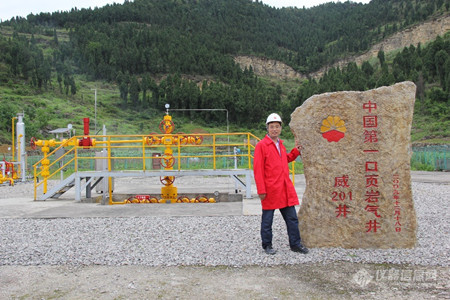
Professor Tang Hongming visiting China’s first shale gas well in Weiyuan, Sichuan
Another key focus of Professor Tang’s research is unconventional reservoir geology, including shale gas and tight oil. His work investigates the controlling factors of high-quality unconventional reservoirs, covering deposition, modelling, diagenesis, heterogeneity, pore structure, and movable fluid saturation. As research deepens, low-field NMR equipment becomes essential for these studies.
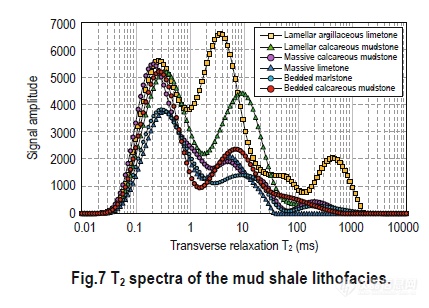
Selected achievements of Professor Tang’s team using NMR
Professor Tang recalls: “During my early graduate studies, I had heard of NMR equipment, but it was mostly imported and extremely expensive. My impression of NMR remained distant until unconventional oil and gas emerged as industry leaders. Low-field NMR literature for exploration and development has grown significantly, and owning an NMR instrument became a dream for our team.”
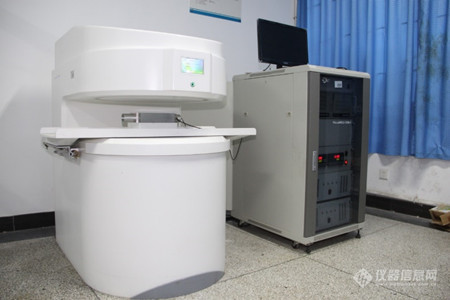
MacroMR12-150H-I Large-Bore NMR Imaging Analyzer
During the 12th Five-Year Plan, central government funding enabled local universities to purchase supporting equipment. After extensive research, Professor Tang’s team acquired Numay’s MacroMR12-150H-I large-bore NMR imaging analyzer. Using T2 spectrum analysis, the team evaluates reservoir movable fluid saturation, porosity, and pore-throat distribution, while imaging technology captures micro-scale oil displacement, long-term water-flooded pore structures, and fracture closure patterns.
Compared to other analytical methods, Professor Tang highlights the irreplaceable advantages of low-field NMR: “It quantitatively characterises fluid distribution and pore structure changes during displacement in situ, without damaging cores. Many cores can be reused, ensuring reproducibility. The vendor’s remote guidance and on-site engineer support also impressed us, ensuring long-term operational reliability.”
Professor Tang adds: “Based on global literature, NMR is now an essential tool for unconventional reservoir research. In the coming years, we expect breakthroughs in tight oil and shale gas studies—including geological characterisation, flow mechanisms, reactions between injected fluids and rock minerals, and imbibition/flowback processes. Low-field NMR will provide critical technical support. With advances in R&D, Numay has developed instruments with new capabilities, and our team plans upgrades when funding and space permit.”
Using Low-Field NMR to “Revitalize” Oil and Gas Reservoirs
Another interviewee, Dr. Lai Jie, is a student of Professor Guo Jianchun, a Yangtze River Scholar and National Outstanding Youth Fund awardee. Professor Guo’s team focuses on enhanced oil recovery technologies, investigating the physical and chemical interactions among rocks, working fluids, and proppants. Their work has achieved breakthroughs in acidising deep heterogeneous carbonate reservoirs, ultra-high temperature fracturing, horizontal well fracture network flow, precise segmentation, and efficient proppant placement techniques.
Dr. Lai mainly studies acidising fluids and techniques for carbonate reservoirs. He explains: “Carbonate rocks primarily consist of calcium carbonate and magnesium calcium carbonate. Acidising involves injecting hydrochloric acid, gelled acid, or diversion acid into rock pores. The acid dissolves parts of the rock, enlarging pore spaces to improve oil and gas flow and extraction efficiency.”
Acidising is key for reservoir enhancement. In carbonates, calcium and magnesium carbonates often exceed 90%, meaning most rock components are reactive to injected acid. However, excessive dissolution can compromise the rock, causing collapse or loss of flow channels. The goal is controlled acidising that expands pore space just enough for hydrocarbons to reach the surface safely.
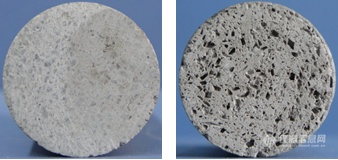
Rock Core Surface Before (Left) and After (Right) Acid Reaction
To ensure orderly flow while maintaining rock pore integrity, researchers study pore structure changes before and after acidising. Micro-scale pore features are examined using low-field NMR alongside traditional techniques such as high-pressure mercury intrusion, gas adsorption, field emission SEM, and CT scanning. NMR is non-destructive, allows real-time observation, and provides high testing efficiency. Cores can be reused, ensuring strong comparability between experiments. With supporting heating and pressure equipment, NMR can simulate subsurface high-temperature, high-pressure conditions, guiding field operations.
Currently, few teams worldwide systematically study acidising with NMR. Leveraging the MacroMR12-150HTHP-I high-temperature, high-pressure flow visualisation and imaging system at Southwest Petroleum University, Professor Guo’s team conducts innovative research in this field.
However, limited existing research brings unexpected challenges, placing higher demands on instrumentation. Dr. Lai notes: “Chemical reactions between acid and carbonate generate calcium and magnesium ions, which create new magnetic fields interfering with existing fields. Acid also corrodes metal containers and pipelines, so instruments must resist acid corrosion.” To address these challenges, the School of Petroleum and Natural Gas Engineering collaborates closely with Numay, exemplifying a new university-industry partnership model.
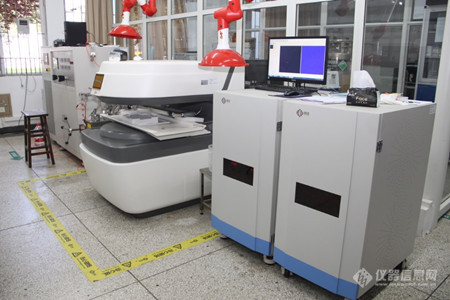
MacroMR12-150HTHP-I High-Temperature, High-Pressure Flow Visualisation and Imaging System, School of Petroleum and Natural Gas Engineering, Southwest Petroleum University
 Scan QR Code
 Scan QR Code
 Phone Support
Phone: 400-060-3233
After-sales: 400-060-3233
 WeChat Support

 Official Account

Back to Top