


Polymer flooding refers to an enhanced oil recovery (EOR) method in which polymers are injected into the reservoir to improve oil displacement. At the macroscopic level, it primarily increases the viscosity of the displacing fluid and reduces the mobility ratio between the displacing and displaced fluids, thereby expanding the swept volume. At the microscopic level, polymers, due to their inherent viscoelasticity, exert stretching forces on oil films or droplets during flow. This increases the carrying capacity of the fluid and enhances microscopic oil displacement efficiency.
Because the mechanism is well understood and the technique is relatively straightforward, polymer flooding has been studied internationally for decades. The United States began laboratory research in the late 1950s and early 1960s, with field trials launched in 1964. Since the 1970s, countries such as the former Soviet Union, Canada, the United Kingdom, France, Romania, and Germany have conducted extensive polymer flooding field experiments. Since the 1960s, more than 200 oilfields or blocks worldwide have tested polymer flooding. By adding a small amount of water-soluble polymer into the injected water, the viscosity of the aqueous phase is increased and its permeability is reduced. This improves the mobility ratio, expands the sweep efficiency, and ultimately raises oil recovery rates.
Polymer flooding is considered one of the most cost-effective EOR methods. The key functions of polymers are to increase water-phase viscosity and reduce permeability due to polymer retention, thereby significantly lowering the mobility of the displacing fluid in the reservoir. Nuclear magnetic resonance (NMR) imaging studies have shown that polymer flooding improves pore utilisation, leading to enhanced oil recovery. Research also suggests that the viscoelasticity of polymer solutions contributes positively to oil displacement efficiency.
Low-field nuclear magnetic resonance (NMR) technology mainly detects hydrogen (H) protons, but it can also be applied to fluorine (F) signal testing. When hydrogen-containing samples are excited by radiofrequency at a specific frequency, they generate NMR signals. These signals are characterised by two key relaxation parameters: T1 and T2. By measuring T1 and T2 relaxation times and applying modelling, low-field NMR is widely used in petroleum exploration, geotechnical studies, and energy research.
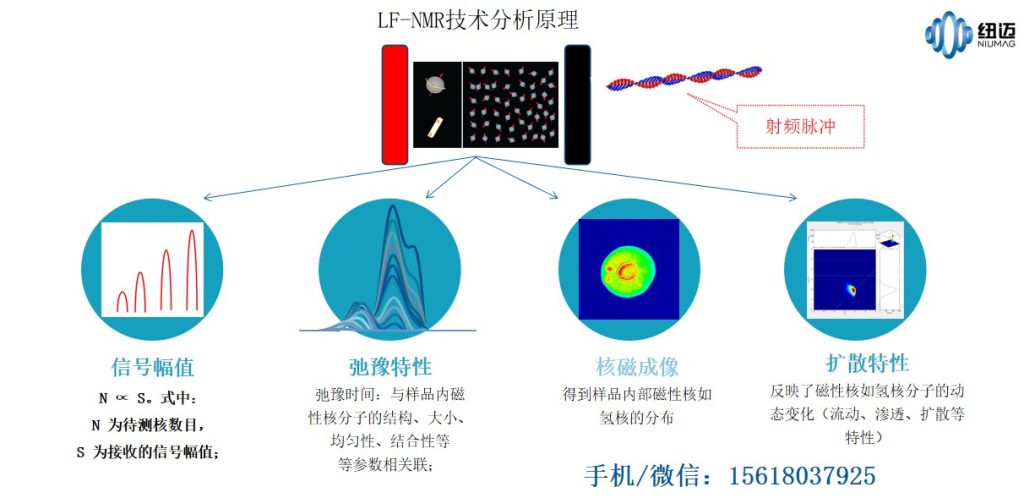
Online NMR imaging uses strong magnetic fields and gradient scanning to capture signals from samples under test. In petroleum exploration and development, it is commonly applied to analyse the relaxation times of reservoir fluids to map oil-water distribution. NMR signals originate from hydrogen atoms: the higher the hydrogen content, the stronger the signal. However, because both water and crude oil contain hydrogen, it is difficult to distinguish between them. To address this, fluorocarbon oil—which contains no hydrogen—is used to replace crude oil in experiments, ensuring that the measured signals originate solely from the water phase. Since only the water phase contains hydrogen in these tests, residual oil saturation in the core correlates directly with the NMR T2 spectrum. By analysing T2 relaxation times, researchers can calculate and compare changes in residual oil distribution after water flooding and polymer flooding, offering valuable insights for enhanced oil recovery.
 Scan QR Code
 Scan QR Code
 Phone Support
Phone: 400-060-3233
After-sales: 400-060-3233
 WeChat Support

 Official Account

Back to Top